29 questions · Based on public Transport WA quiz material and the Drive Safe handbook · English explanations and handbook references
Q0237Quiz 9Overtaking · Lanes
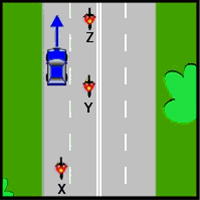
Which motorcycle is in the car driver's blind spot?
AMotorcycle Z.
BMotorcycle Y.
CMotorcycle X.
View answer and explanation
Answer: B
Motorcycle Y is alongside the car in the adjacent lane, in the area that is typically hidden from the driver's view in both the rear-view and side mirrors—the blind spot.
📖 Reference: 1.11 / 3.15 — Blind spots. There are blind spots at the sides and rear of your vehicle that cannot be seen in the mirrors. Check your blind spots by glancing over your shoulder before you move left or right.
Q0238Quiz 9Give Way · Intersections
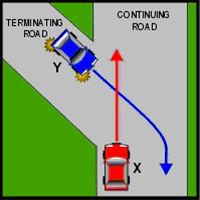
Which vehicle must give way?
ANeither vehicle has to give way.
BVehicle X.
CVehicle Y.
View answer and explanation
Answer: C
Vehicle Y is on the terminating road and must give way to all vehicles on the continuing road, which includes Vehicle X.
📖 Reference: 3.13 — Intersections (give way). Give way to all traffic coming from the left or right, including turning vehicles. A vehicle entering a road from a driveway or terminating road must give way to traffic on the continuing road.
Q0239Quiz 9Seatbelts · Vehicle
When is a driver allowed to drive without a seat belt?
AWhen reversing a vehicle.
BWhen aged 65 years and over.
CWhen the driver is pregnant.
View answer and explanation
Answer: A
When reversing, you may temporarily not wear your seatbelt.
📖 Reference: 1.4.4 — Who must wear a seat belt?. The driver and each passenger must be appropriately restrained and in a seated position. Seat belts must be worn by pregnant women. Children under 7 years must wear a suitable child restraint. You do not have to wear a seat belt when reversing.
Q0240Quiz 9Speed · Distances
What is the maximum speed vehicles towing a caravan or trailer are allowed to travel?
A110km/h.
B90km/h.
C100km/h.
View answer and explanation
Answer: C
The speed limit for a towed caravan is 100 km/h.
📖 Reference: 3.1.1 — Speed Limits. In a ‘built-up’ area, the default speed limit is 50 km/h unless a sign shows a different speed. Learner drivers: 100 km/h. Vehicles towing caravans or trailers: 100 km/h. Roadworks: obey the speed limit shown on the sign.
Q0241Quiz 9Turning · U-turns
On an unmarked road, what position must your vehicle be if you are not preparing to turn or overtake?
AAny position, providing there is no traffic.
BNear the centre of the road.
CClose to the left-hand side of the road.
View answer and explanation
Answer: C
No turning, no overtaking: keep left.
📖 Reference: 3.14.2 / 3.4 — Turning / Keeping to the Left. When turning left you must move close to the left side of the road. When lanes are not marked, before turning right move as close as possible to the left of the centre of the road. If not preparing to turn, keep as far to the left of the road as practicable.
Q0242Quiz 9Give Way · Intersections
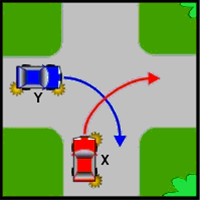
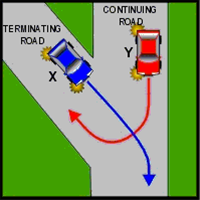
Which vehicle must give way?
AVehicle X.
BNeither vehicle has to give way.
CVehicle Y.
View answer and explanation
Answer: C
📖 Reference: 3.13 — Intersections (give way). Give way to all traffic coming from the left or right, including turning vehicles. A vehicle entering a road from a driveway or terminating road must give way to traffic on the continuing road.
Q0243Quiz 9Speed · Distances
About how long does it take an alert driver to react to an emergency?
AOne tenth of a second.
B10 seconds.
CAt least 1 second.
View answer and explanation
Answer: C
Reaction time is about 1 second.
📖 Reference: 3.2.2 — How long does it take to stop your car?. An alert driver takes at least 1 second to react to an emergency. Stopping distance = reaction distance + braking distance. Wet roads, poor tyres or brakes increase stopping distance.
Q0244Quiz 9Emergencies · First Aid
What is the best way to control bleeding from a wound?
AApply antiseptic cream to the wound.
BApply direct pressure to the wound.
CCover the wound with a light bandage.
View answer and explanation
Answer: B
Stop bleeding: apply direct pressure to the wound.
📖 Reference: 4.3.1 — When the injured person is bleeding. To stop external bleeding: apply direct pressure to the wound, using whatever is available (your hands or an item of clothing), then bandage it.
Q0245Quiz 9Stopping · Parking
Are you allowed to park a vehicle on a footpath?
ANo.
BYes, if it is a passenger vehicle.
CYes.
View answer and explanation
Answer: A
Parking on the sidewalk is prohibited.
📖 Reference: 3.17 — Stopping. You must not stop: within 10 metres of an intersection; within 20 metres of the approach side and 10 metres of the leaving side of a pedestrian/children’s crossing or bus stop; within one metre of a fire hydrant; within 20 metres of a railway crossing; within 3 metres of a letter box; or on a footpath.
Q0246Quiz 9Alcohol · Drugs
What is the minimum penalty for a provisional driver with a BAC over 0.00%?
AA fine.
BA fine and accrual of demerit points.
CA fine and loss of licence.
View answer and explanation
Answer: B
Official answer: fine + demerit points. For a provisional licence, exceeding 0.00% BAC has a minimum penalty that includes demerit points.
📖 Reference: 1.3.3 / 1.3.4 — Blood alcohol concentration (BAC). All novice drivers are subject to a zero blood alcohol limit (0.00%). The BAC limit for full licence drivers is 0.05%. Alcohol slows down your reaction time to road hazards and gives you a false sense of confidence.
Q0247Quiz 9Overtaking · Lanes
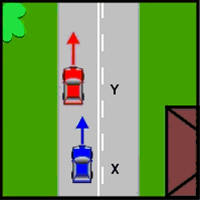
Is vehicle X allowed to overtake vehicle Y?
AYes, if it is safe to do so.
BNo.
CIt depends on the time of day.
View answer and explanation
Answer: B
Official answer: No. In this diagram, X is not allowed to overtake Y.
📖 Reference: 3.16 — Overtaking. To overtake safely you must get a good view of the road ahead, check mirrors and blind spots, and only overtake when it is safe. You must not exceed the speed limit to overtake, and you must not overtake unless it can be done safely.
Q0248Quiz 9Traffic Lights
Are you allowed to make a 'U' turn at traffic lights?
AYes.
BNo, unless there is a 'U' TURN PERMITTED sign.
CYes, if the traffic lights are not working.
View answer and explanation
Answer: B
At signalized intersections, U-turns are prohibited unless a sign allows them.
📖 Reference: 3.14.3 — ‘U’ turns. You must not make a ‘U’ turn at traffic control signals unless there is a ‘U TURN PERMITTED’ sign.
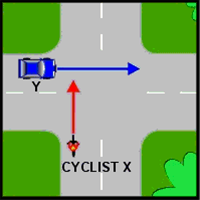
Q0249Quiz 9Pedestrians · Buses
Who must give way?
AVehicle Y.
BNeither has to give way.
CThe cyclist X.
View answer and explanation
Answer: A
Vehicle Y must give way because there are give way lines (dashed white lines) across its lane at the intersection, requiring it to yield to traffic on the intersecting road (Cyclist X).
📖 Reference: 3.13 — Intersections (give way). Give way to all traffic coming from the left or right, including turning vehicles. A vehicle entering a road from a driveway or terminating road must give way to traffic on the continuing road.
Q0250Quiz 9Give Way · Intersections
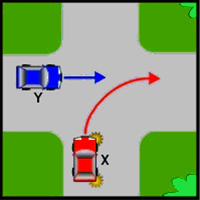
Which vehicle must give way?
AVehicle Y.
BNeither vehicle has to give way.
CVehicle X.
View answer and explanation
Answer: C
📖 Reference: 3.13 — Intersections (give way). Give way to all traffic coming from the left or right, including turning vehicles. A vehicle entering a road from a driveway or terminating road must give way to traffic on the continuing road.
Q0251Quiz 9Mobile · Fatigue
Which of the following statements is correct?
AYou should not drive if you are tired.
BYour level of fatigue will be increased if you make stops on long trips.
CYou are more likely to become fatigued on short curving roads.
View answer and explanation
Answer: A
Do not drive when tired.
📖 Reference: 3.13 — Intersections (give way). Give way to all traffic coming from the left or right, including turning vehicles. A vehicle entering a road from a driveway or terminating road must give way to traffic on the continuing road.
Q0252Quiz 9Stopping · Parking
What is the minimum distance a vehicle is allowed to park from a public letter box?
A3 metres.
B5 metres.
C1 metre.
View answer and explanation
Answer: A
No parking within 3 meters of a public mailbox.
📖 Reference: 3.17 — Stopping. You must not stop: within 10 metres of an intersection; within 20 metres of the approach side and 10 metres of the leaving side of a pedestrian/children’s crossing or bus stop; within one metre of a fire hydrant; within 20 metres of a railway crossing; within 3 metres of a letter box; or on a footpath.
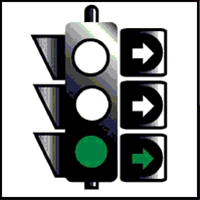
Q0253Quiz 9Traffic Lights
When approaching traffic lights, what does a green light with a green arrow (as shown in the diagram) mean?
AYou may turn right only.
BYou may turn right or drive straight ahead.
CYou may drive straight ahead only.
View answer and explanation
Answer: B
The provided text is already in English, so there’s nothing to translate from Chinese. For a study app, here’s a natural, concise version:
"A green circular light means you may go straight ahead. A green arrow means you may also turn right, in the direction of the arrow."
📖 Reference: 3.10.1 — Intersection traffic control signals. Red means STOP. When the light is red, you must wait behind the stop line. A green arrow permits movement in the direction of the arrow; other lights still apply to other directions.
Q0254Quiz 9Lights · Weather
When should you dip your headlights?
AWhen you are within 50 metres of a vehicle.
BWhen you are within 200 metres of a vehicle.
CWhen you are dazzled by the lights of an on-coming vehicle.
View answer and explanation
Answer: B
Switch to low beam when within 200 meters of an oncoming vehicle.
📖 Reference: 3.3.1 / 3.3.3 — Driving at night / in fog. Drive with your headlights on between sunset and sunrise. You are legally required to dip your headlights within 200 metres of an approaching vehicle or when driving less than 200 metres behind another vehicle. In fog or smoke, dip your headlights and drive slowly.
Q0255Quiz 9Overtaking · Lanes
Which of the following statements is correct?
AVehicle X may overtake Y, only in a 60km/h area.
BVehicle X may overtake Y.
CVehicle X must not overtake Y.
View answer and explanation
Answer: B
Official answer: Vehicle X may overtake Y (confirmed by official scoring).
📖 Reference: 3.13 — Intersections (give way). Give way to all traffic coming from the left or right, including turning vehicles. A vehicle entering a road from a driveway or terminating road must give way to traffic on the continuing road.
Q0256Quiz 9Alcohol · Drugs
What is the legal blood alcohol concentration (BAC) for novice drivers?
A0.00%.
B0.02%.
C0.05%
View answer and explanation
Answer: A
New drivers: BAC = 0.00%.
📖 Reference: 1.3.3 / 1.3.4 — Blood alcohol concentration (BAC). All novice drivers are subject to a zero blood alcohol limit (0.00%). The BAC limit for full licence drivers is 0.05%. Alcohol slows down your reaction time to road hazards and gives you a false sense of confidence.
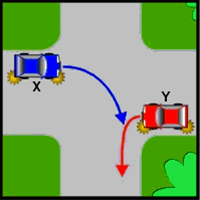
Q0257Quiz 9Give Way · Intersections
Which vehicle must give way?
AVehicle X.
BVehicle Y.
CNeither vehicle has to give way.
View answer and explanation
Answer: A
The provided text is already in English. A more natural version for the app: "Vehicle X is on the road that ends, so it must give way to all vehicles on the road that continues, including Vehicle Y."
📖 Reference: 3.13 — Intersections (give way). Give way to all traffic coming from the left or right, including turning vehicles. A vehicle entering a road from a driveway or terminating road must give way to traffic on the continuing road.
Q0258Quiz 9Speed · Distances
Which of the following is greater?
AYour braking distance.
BYour stopping distance.
CYour reaction distance.
View answer and explanation
Answer: B
The stopping distance is at its maximum.
📖 Reference: 3.2.2 — How long does it take to stop your car?. Stopping distance is the total of reaction distance plus braking distance – it is always the greatest of the three.
Q0259Quiz 9Give Way · Intersections
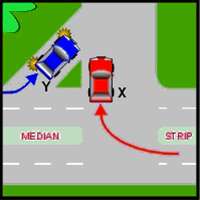
Which vehicle must give way?
AVehicle X.
BVehicle Y.
CNeither vehicle has to give way.
View answer and explanation
Answer: B
Vehicle Y is merging from a slip lane (as shown by the give-way markings and its angled position). It must give way to Vehicle X, which is travelling in the main lane.
📖 Reference: 3.13 — Intersections (give way). Give way to all traffic coming from the left or right, including turning vehicles. A vehicle entering a road from a driveway or terminating road must give way to traffic on the continuing road.
Q0260Quiz 9Traffic Lights
What is the minimum distance a vehicle is allowed to park from an intersection controlled by traffic lights?
A3 metres.
B6 metres.
C20 metres.
View answer and explanation
Answer: C
No parking within 20 meters of an intersection with traffic lights.
📖 Reference: 3.17 — Stopping. You must not stop: within 10 metres of an intersection; within 20 metres of the approach side and 10 metres of the leaving side of a pedestrian/children’s crossing or bus stop; within one metre of a fire hydrant; within 20 metres of a railway crossing; within 3 metres of a letter box; or on a footpath.
Q0261Quiz 9Turning · U-turns
On an unmarked road, what position must your vehicle be before making a left-hand turn?
AAny position, providing there is no traffic.
BIn the centre of the road.
CAs close to the left-hand side of the road as possible.
View answer and explanation
Answer: C
If there are no lane markings, keep left before turning left.
📖 Reference: 3.14.2 / 3.4 — Turning / Keeping to the Left. When turning left you must move close to the left side of the road. When lanes are not marked, before turning right move as close as possible to the left of the centre of the road. If not preparing to turn, keep as far to the left of the road as practicable.
Q0262Quiz 9Seatbelts · Vehicle
Which of the following statements is correct?
ATyres with no tread are just as safe as tyres with tread as long as the tyre pressure is correct.
BTyre pressure should be checked when the tyres are hot.
CTyre tread must be at least 1.5mm deep over all parts of the tyre that normally come in contact with the road.
View answer and explanation
Answer: C
Tire tread must be at least 1.5mm deep.
📖 Reference: 3.13 — Intersections (give way). Give way to all traffic coming from the left or right, including turning vehicles. A vehicle entering a road from a driveway or terminating road must give way to traffic on the continuing road.
Q0263Quiz 9Seatbelts · Vehicle
Are people over 65 years of age required to wear a seat belt?
ANo, if they are passengers.
BYes.
CNo, if they are driving.
View answer and explanation
Answer: B
People aged 65 and above must also wear seat belts.
📖 Reference: 1.4.4 — Who must wear a seat belt?. The driver and each passenger must be appropriately restrained and in a seated position. Seat belts must be worn by pregnant women. Children under 7 years must wear a suitable child restraint. You do not have to wear a seat belt when reversing.
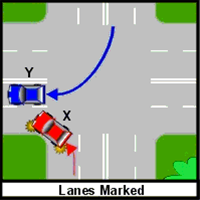
Q0264Quiz 9Give Way · Intersections
Which vehicle must give way?
AVehicle Y.
BNeither vehicle has to give way.
CVehicle X.
View answer and explanation
Answer: A
Official answer: Vehicle Y gives way (confirmed in the official marking scheme).
📖 Reference: 3.13 — Intersections (give way). Give way to all traffic coming from the left or right, including turning vehicles. A vehicle entering a road from a driveway or terminating road must give way to traffic on the continuing road.
Q0265Quiz 9Speed · Distances
What is the maximum speed learner drivers (L-plates) are allowed to travel?
A110km/h.
B90km/h.
C100km/h.
View answer and explanation
Answer: C
L-plate learners have a speed limit of 100 km/h.
📖 Reference: 3.1.1 — Speed Limits. In a ‘built-up’ area, the default speed limit is 50 km/h unless a sign shows a different speed. Learner drivers: 100 km/h. Vehicles towing caravans or trailers: 100 km/h. Roadworks: obey the speed limit shown on the sign.