29 questions · Based on public Transport WA quiz material and the Drive Safe handbook · English explanations and handbook references
Q0121Quiz 5Alcohol · Drugs
Is it an offence to refuse a breath test for alcohol?
ANo, providing you have a doctor's certificate.
BYes.
CNo.
View answer and explanation
Answer: B
Refusing to take a breath test is illegal.
📖 Reference: 1.3.3 / 1.3.4 — Blood alcohol concentration (BAC). All novice drivers are subject to a zero blood alcohol limit (0.00%). The BAC limit for full licence drivers is 0.05%. Alcohol slows down your reaction time to road hazards and gives you a false sense of confidence.
Q0122Quiz 5Pedestrians · Buses
When driving, what should you do if a ball suddenly bounces across the road in front of you?
ASlow down and be prepared to stop.
BSpeed up and pass the danger area.
CSteer to avoid hitting the ball.
View answer and explanation
Answer: A
A ball rolling onto the road means a child may be chasing it. Slow down and be ready to stop.
📖 Reference: 1.8.1 — Pedestrians. Always be ready to stop for pedestrians, especially near schools and playgrounds. A ball bouncing onto the road means children may follow – slow down and be prepared to stop.
Q0123Quiz 5Markings · Signs
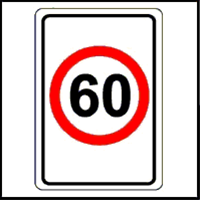
What is the meaning of this sign?
ADo not exceed 60km/h unless the road is clear.
BThe recommended speed is 60km/h.
CDo not exceed 60km/h at any time.
View answer and explanation
Answer: C
A speed limit sign with a number inside a red circle indicates the maximum legal speed you’re allowed to drive on that road.
📖 Reference: 3.8 — Traffic Signs. Signs are installed along our roads to make them safer for all users. Regulatory signs control traffic and must be obeyed; warning signs (diamond-shaped) alert you to hazards ahead.
Q0124Quiz 5Give Way · Intersections
When you want to cross an intersection, but you can see that the traffic ahead of you is banked up on the other side of the intersection, what must you do?
ASound your horn and move slowly forward.
BStop before entering and make sure that you will not block the intersection if you join the queue.
CJoin the queue of traffic.
View answer and explanation
Answer: B
If traffic is backed up at the intersection ahead, stop before entering and don’t block the intersection.
📖 Reference: 3.13.4 — Keep intersections clear. Do not enter an intersection when a queue of traffic prevents you from fully exiting on the other side. Stop before you enter the intersection so that you do not block crossing traffic.
Q0125Quiz 5Markings · Signs
What does a broken white line down the centre of a road mean?
AYou must not cross the broken white line.
BYou may only cross the broken white line to turn right.
CYou may cross the broken white line when overtaking or turning right, if it is safe to do so.
View answer and explanation
Answer: C
Dashed center line: you may cross it to overtake or turn right when it is safe.
📖 Reference: 3.9 — Road Markings. Broken white lines (dashed) separate lanes and may be crossed to overtake or turn right when it is safe to do so.
Q0126Quiz 5Railway Crossings
What should you do when approaching a railway crossing?
ASpeed up to clear the crossing quickly.
BSlow down and be prepared to stop.
CSound your horn.
View answer and explanation
Answer: B
Approaching a railway crossing: slow down and prepare to stop.
📖 Reference: 3.5 — Railway Crossings. You must stop if warning bells or flashing red lights are operating, boom gates are down, or a train is coming. You may drive on only when it is safe and no train is approaching; if lights are still flashing you must not cross.
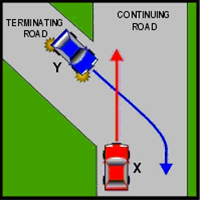
Q0127Quiz 5Give Way · Intersections
Which vehicle must give way?
AVehicle X.
BVehicle Y.
CNeither vehicle has to give way.
View answer and explanation
Answer: A
📖 Reference: 3.13 — Intersections (give way). Give way to all traffic coming from the left or right, including turning vehicles. A vehicle entering a road from a driveway or terminating road must give way to traffic on the continuing road.
Q0128Quiz 5Pedestrians · Buses
Which of the following statements is correct?
AOrnaments hanging from the rear view mirror will stop you becoming fatigued when you are driving.
BSunglasses worn at night will reduce the glare from the headlights of on-coming vehicles.
CYou should take extra care looking for cyclists or pedestrians at night.
View answer and explanation
Answer: C
Pay special attention to cyclists and pedestrians at night.
📖 Reference: 3.13 — Intersections (give way). Give way to all traffic coming from the left or right, including turning vehicles. A vehicle entering a road from a driveway or terminating road must give way to traffic on the continuing road.
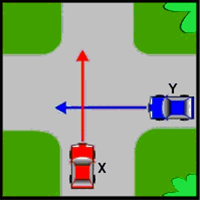
Q0129Quiz 5Give Way · Intersections
Which vehicle must give way?
ANeither vehicle has to give way.
BVehicle X.
CVehicle Y.
View answer and explanation
Answer: B
The provided text is already in English. Here is a natural version for a study app: "At an intersection without traffic lights or signs, you must give way to any vehicle approaching from your right. Vehicle X must therefore give way to Vehicle Y."
📖 Reference: 3.13 — Intersections (give way). Give way to all traffic coming from the left or right, including turning vehicles. A vehicle entering a road from a driveway or terminating road must give way to traffic on the continuing road.
Q0130Quiz 5Pedestrians · Buses
When passing a row of parked vehicles, what should you do?
AMove as close to the centre of the road as possible and speed up.
BWatch out for pedestrians who might step out suddenly.
CSound your horn.
View answer and explanation
Answer: B
When passing parked vehicles at the roadside, watch for pedestrians stepping out suddenly.
📖 Reference: 1.8.1 — Pedestrians. Watch out for pedestrians who might step out suddenly from between parked cars. Always keep a look out for pedestrians and be ready to stop for them.
Q0131Quiz 5Turning · U-turns
On a two-way road with no lanes marked, what position must your vehicle be before making a right-hand turn?
AOver the centre of the road.
BAs close to the left-hand side of the road as possible.
CTo the left of, the centre of the road.
View answer and explanation
Answer: C
Handbook 3.14.2: Before turning right on an unmarked road, stay as close as possible to the left of the centre of the road, then turn to the right of the intersection centre.
📖 Reference: 3.14.2 / 3.4 — Turning / Keeping to the Left. When turning left you must move close to the left side of the road. When lanes are not marked, before turning right move as close as possible to the left of the centre of the road. If not preparing to turn, keep as far to the left of the road as practicable.
Q0132Quiz 5Speed · Distances
About how long does it take an alert driver to react to an emergency?
AOne tenth of a second.
B10 seconds.
CAt least 1 second.
View answer and explanation
Answer: C
An alert driver's reaction time is about 1 second.
📖 Reference: 3.2.2 — How long does it take to stop your car?. An alert driver takes at least 1 second to react to an emergency. Stopping distance = reaction distance + braking distance. Wet roads, poor tyres or brakes increase stopping distance.
Q0133Quiz 5Speed · Distances
Are you allowed to travel faster than the speed limit when you are overtaking a vehicle?
ANo.
BYes.
CYes, if the driver of the vehicle in front signals you to overtake.
View answer and explanation
Answer: A
Even when overtaking, you must not exceed the speed limit.
📖 Reference: 3.16 — Overtaking. To overtake safely you must get a good view of the road ahead, check mirrors and blind spots, and only overtake when it is safe. You must not exceed the speed limit to overtake, and you must not overtake unless it can be done safely.
Q0134Quiz 5Seatbelts · Vehicle
Are people over 65 years of age required to wear a seat belt?
ANo, if they are passengers.
BYes.
CNo, if they are driving.
View answer and explanation
Answer: B
Those aged 65 and over must also wear seat belts.
📖 Reference: 1.4.4 — Who must wear a seat belt?. The driver and each passenger must be appropriately restrained and in a seated position. Seat belts must be worn by pregnant women. Children under 7 years must wear a suitable child restraint. You do not have to wear a seat belt when reversing.
Q0135Quiz 5Alcohol · Drugs
What is the legal blood alcohol concentration (BAC) for novice drivers?
A0.00%.
B0.02%.
C0.05%.
View answer and explanation
Answer: A
For new drivers, the legal BAC limit is 0.00%.
📖 Reference: 1.3.3 / 1.3.4 — Blood alcohol concentration (BAC). All novice drivers are subject to a zero blood alcohol limit (0.00%). The BAC limit for full licence drivers is 0.05%. Alcohol slows down your reaction time to road hazards and gives you a false sense of confidence.
Q0136Quiz 5Seatbelts · Vehicle
Who will be fined if a passenger under the age of 16 is not wearing a seat belt or suitable child restraint?
AThe owner of the vehicle.
BThe passenger.
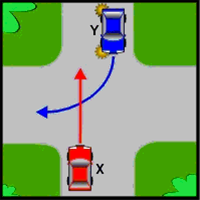
CThe driver of the vehicle.
View answer and explanation
Answer: C
If a passenger under 16 isn't wearing a seatbelt, the driver gets the fine.
📖 Reference: 1.4.4 — Who must wear a seat belt?. The driver and each passenger must be appropriately restrained and in a seated position. Seat belts must be worn by pregnant women. Children under 7 years must wear a suitable child restraint. You do not have to wear a seat belt when reversing.
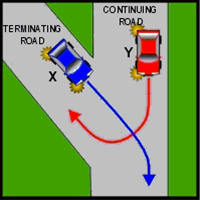
Q0137Quiz 5Give Way · Intersections
Which vehicle must give way?
ANeither vehicle has to give way.
BVehicle X.
CVehicle Y.
View answer and explanation
Answer: C
Vehicle Y is on the terminating road and must give way to all traffic on the continuing road, which includes Vehicle X.
📖 Reference: 3.13 — Intersections (give way). Give way to all traffic coming from the left or right, including turning vehicles. A vehicle entering a road from a driveway or terminating road must give way to traffic on the continuing road.
Q0138Quiz 5Pedestrians · Buses
What should you do to improve safety when travelling in heavy rain?
AUse your headlights and watch out for pedestrians’, cyclists and other hazards.
BTurn on your radio to block out the sound of the rain.
CDrive the same as you would in dry weather conditions.
View answer and explanation
Answer: A
In heavy rain: turn on your lights and watch out for pedestrians, cyclists, and other hazards.
📖 Reference: 3.3.2 — Driving in wet or hazardous weather. When the road is wet, braking distance increases; braking hard on a wet road may cause your car to skid. To improve safety in wet weather, use your headlights and watch out for pedestrians, cyclists and other hazards.
Q0139Quiz 5Give Way · Intersections
Which vehicle must give way?
ANeither vehicle has to give way.
BVehicle X.
CVehicle Y.
View answer and explanation
Answer: C
The text you provided is already in English. If you meant to send the Chinese version, please resend it. For now, here’s a clear, natural way to phrase the explanation: Vehicle Y is turning right across the path of Vehicle X, which is going straight, so Vehicle Y must give way.
📖 Reference: 3.13 — Intersections (give way). Give way to all traffic coming from the left or right, including turning vehicles. A vehicle entering a road from a driveway or terminating road must give way to traffic on the continuing road.
Q0140Quiz 5Alcohol · Drugs
Can medication used for colds or travel sickness affect your driving?
ANo.
BYes.
CNo, unless it has been prescribed by a doctor.
View answer and explanation
Answer: B
Cold medicine or motion sickness medication can affect your driving.
📖 Reference: 1.3.6 — Effect of alcohol and other drugs on driving. Medications for the common cold or travel sickness can seriously affect your driving ability. Check with your doctor or chemist about the effect they may have.
Q0141Quiz 5Markings · Signs
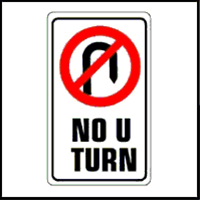
If there is no traffic in sight, can you disregard this sign?
ANo.
BYes.
CYes, if the road is wide enough.
View answer and explanation
Answer: A
Regulatory signs that prohibit a maneuver—such as a "No U Turn" sign—must always be obeyed, no matter the traffic conditions.
📖 Reference: 3.8 — Traffic Signs. Regulatory signs control traffic and you must obey them at all times – a sign applies whether or not other traffic is in sight.
Q0142Quiz 5Speed · Distances
What should you do when a driver is indicating to overtake you?
ASpeed up if you are travelling under the speed limit.
BMove as far to the left as possible and do not increase your speed
CSignal the driver to remain behind you if you think he or she is travelling too fast.
View answer and explanation
Answer: B
When being overtaken: keep as far left as possible, and do not accelerate.
📖 Reference: 3.16 — Overtaking. To overtake safely you must get a good view of the road ahead, check mirrors and blind spots, and only overtake when it is safe. You must not exceed the speed limit to overtake, and you must not overtake unless it can be done safely.
Q0143Quiz 5Speed · Distances
On a dry road and in good weather, what is the minimum gap you should allow between your vehicle and the one in front of you?
AAt least 2 seconds.
BAt least 5 seconds.
CAbout 3 car lengths.
View answer and explanation
Answer: A
On dry roads in good weather: keep at least a 2-second gap from the vehicle ahead.
📖 Reference: 3.2.1 — The ‘Two Second’ rule. Slow down until you are at least two seconds behind the vehicle ahead. Always remember to allow a ‘cushion of space’.
Q0144Quiz 5Lights · Weather
What should you do when travelling behind a vehicle in wet weather?
ADrive the same as you would in dry weather conditions.
BKeep a greater distance behind the vehicle than normal.
CKeep a closer distance behind the vehicle than normal.
View answer and explanation
Answer: B
On rainy days, you should leave a greater following distance between your car and the vehicle ahead.
📖 Reference: 3.3.2 — Driving in wet or hazardous weather. When the road is wet, braking distance increases; braking hard on a wet road may cause your car to skid. To improve safety in wet weather, use your headlights and watch out for pedestrians, cyclists and other hazards.
Q0145Quiz 5Give Way · Intersections
Which vehicle must give way?
AVehicle X.
BVehicle Y.
CNeither vehicle has to give way.
View answer and explanation
Answer: B
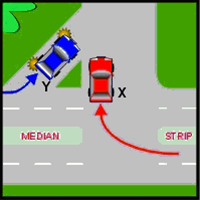
When Y enters the main road from a driveway or ramp, they must yield to X already traveling on the main road. Both models agree on this fact-check.
📖 Reference: 3.13 — Intersections (give way). Give way to all traffic coming from the left or right, including turning vehicles. A vehicle entering a road from a driveway or terminating road must give way to traffic on the continuing road.
Q0146Quiz 5Give Way · Intersections
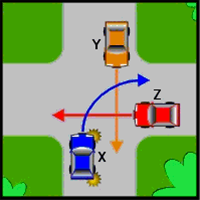
Which of the following statements is correct?
AVehicle X gives way to both Y and Z.
BVehicle Y gives way to both X and Z.
CVehicle Z gives way to both X and Y.
View answer and explanation
Answer: A
Vehicle X is turning right and/or facing a Give Way sign, so it must give way to oncoming traffic going straight (Vehicle Y) and traffic approaching from the right (Vehicle Z).
📖 Reference: 3.13 — Intersections (give way). Give way to all traffic coming from the left or right, including turning vehicles. A vehicle entering a road from a driveway or terminating road must give way to traffic on the continuing road.
Q0147Quiz 5Traffic Lights
When approaching traffic lights, what does a green light with a red arrow mean?
AYou may go in any direction other than that indicated by the arrow.
BYou may turn in the direction of the arrow, if it is safe to do so.
CStop, the lights are not working properly.
View answer and explanation
Answer: A
Green light with a red arrow: you may proceed in any direction except the one the arrow points to.
📖 Reference: 3.10.1 — Intersection traffic control signals. Red means STOP. When the light is red, you must wait behind the stop line. A green arrow permits movement in the direction of the arrow; other lights still apply to other directions.
Q0148Quiz 5Turning · U-turns
On an unmarked road, what position must your vehicle be before making a left-hand turn?
AAny position, providing there is no traffic.
BIn the centre of the road.
CAs close to the left-hand side of the road as possible.
View answer and explanation
Answer: C
Before turning left on a road without lane markings, keep as far left as possible.
📖 Reference: 3.14.2 / 3.4 — Turning / Keeping to the Left. When turning left you must move close to the left side of the road. When lanes are not marked, before turning right move as close as possible to the left of the centre of the road. If not preparing to turn, keep as far to the left of the road as practicable.
Q0149Quiz 5Markings · Signs
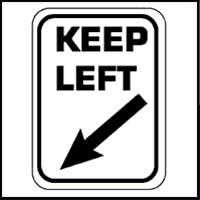
What is the meaning of this sign?
ATurn left at the next street.
BPass on the left of traffic.
CKeep to the left of the sign.
View answer and explanation
Answer: C
The sign clearly shows the text "KEEP LEFT" with an arrow pointing down to the left, telling drivers they must pass on the left side of the sign or the obstacle it marks.
📖 Reference: 3.8 — Traffic Signs. Signs are installed along our roads to make them safer for all users. Regulatory signs control traffic and must be obeyed; warning signs (diamond-shaped) alert you to hazards ahead.