29 questions · Based on public Transport WA quiz material and the Drive Safe handbook · English explanations and handbook references
Q0266Quiz 10Seatbelts · Vehicle
At what age does a person have to wear a seat belt or suitable child restraint?
AAll ages.
BAge 1 year and over.
CAge 8 years and over.
View answer and explanation
Answer: A
All ages must wear seat belts.
📖 Reference: 1.4.4 — Who must wear a seat belt?. The driver and each passenger must be appropriately restrained and in a seated position. Seat belts must be worn by pregnant women. Children under 7 years must wear a suitable child restraint. You do not have to wear a seat belt when reversing.
Q0267Quiz 10Traffic Lights
Are you allowed to make a 'U' turn at traffic lights?
AYes.
BNo, unless there is a 'U' TURN PERMITTED sign.
CYes, if the traffic lights are not working.
View answer and explanation
Answer: B
At signalized intersections, U-turns are prohibited unless a sign allows them.
📖 Reference: 3.14.3 — ‘U’ turns. You must not make a ‘U’ turn at traffic control signals unless there is a ‘U TURN PERMITTED’ sign.
Q0268Quiz 10Speed · Distances
What is the speed limit where roads are under construction or repair?
A20km/h.
BThe speed limit shown on the road works sign.
C40km/h.
View answer and explanation
Answer: B
In construction zones, follow the speed limit posted on the signs.
📖 Reference: 3.1.1 — Speed Limits. In a ‘built-up’ area, the default speed limit is 50 km/h unless a sign shows a different speed. Learner drivers: 100 km/h. Vehicles towing caravans or trailers: 100 km/h. Roadworks: obey the speed limit shown on the sign.
Q0269Quiz 10Alcohol · Drugs
Does drinking alcohol and driving increase the risk of having a crash?
AYes.
BNo.
CNo, providing you drink coffee before you drive.
View answer and explanation
Answer: A
Drinking and driving increases the risk of accidents.
📖 Reference: 1.3.3 / 1.3.4 — Blood alcohol concentration (BAC). All novice drivers are subject to a zero blood alcohol limit (0.00%). The BAC limit for full licence drivers is 0.05%. Alcohol slows down your reaction time to road hazards and gives you a false sense of confidence.
Q0270Quiz 10Turning · U-turns
Do you need to indicate if you are turning from a one-way street into another one-way street?
AYes.
BYes, only if there is a vehicle behind you.
CNo.
View answer and explanation
Answer: A
You must signal for every turn.
📖 Reference: 3.11 — Indicators and Hand Signals. Indicate/signal for a sufficient distance prior to turning or diverging to warn other drivers and pedestrians of your intentions. You must indicate whenever you intend to turn, change lanes or diverge.
Q0271Quiz 10Give Way · Intersections
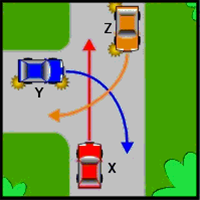
Which of the following statements is correct?
AVehicle Y gives way to both X and Z.
BVehicle X gives way to both Y and Z.
CVehicle Z gives way to both X and Y.
View answer and explanation
Answer: A
Vehicle Y is on the terminating road of a T-intersection (indicated by the give way lines) and must give way to all vehicles travelling on the continuing road (Vehicles X and Z).
📖 Reference: 3.13 — Intersections (give way). Give way to all traffic coming from the left or right, including turning vehicles. A vehicle entering a road from a driveway or terminating road must give way to traffic on the continuing road.
Q0272Quiz 10Pedestrians · Buses
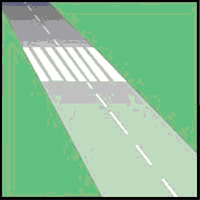
Are you allowed to park a vehicle on a pedestrian crossing?
AYes, if no pedestrians are using it.
BYes, if it is a passenger vehicle.
CNo.
View answer and explanation
Answer: C
Parking or stopping on a pedestrian crossing is illegal because it obstructs pedestrians' path and visibility.
📖 Reference: 1.8.1 — Pedestrians. Always keep a look out for pedestrians and be ready to stop for them. Give way to pedestrians crossing at intersections and at pedestrian/children’s crossings. At children’s crossings you must stop when the crossing attendant extends the flags.
Q0273Quiz 10Turning · U-turns
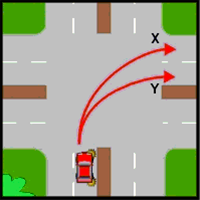
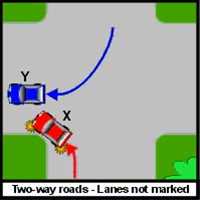
Which is the correct path for the vehicle to take when turning into a two-lane road?
AX is the correct path.
BY is the correct path.
CBoth paths are correct.
View answer and explanation
Answer: C
Official answer: Both paths are correct.
📖 Reference: 3.14.2 — Turning. When turning right you must: indicate/signal before you turn; when lanes are not marked, move as close as possible to the left of the centre of the road and turn to the right of the centre of the intersection; give way to pedestrians.
Q0274Quiz 10Pedestrians · Buses
What is the minimum distance a vehicle is allowed to park before a bus stop or pedestrian crossing?
A20 metres.
B3 metres.
C6 metres.
View answer and explanation
Answer: A
No parking within 20 meters before a bus stop or pedestrian crossing.
📖 Reference: 3.6 — Buses and Taxis. You must give way to a bus moving out from a bus stop in a ‘built-up’ area providing the bus is indicating and has a ‘GIVE WAY’ sign displayed on the back.
Q0276Quiz 10Alcohol · Drugs
Can medication used for colds or travel sickness affect your driving?
ANo.
BYes.
CNo, unless it has been prescribed by a doctor.
View answer and explanation
Answer: B
Cold medicine or motion-sickness medication may affect driving.
📖 Reference: 1.3.6 — Effect of alcohol and other drugs on driving. Medications for the common cold or travel sickness can seriously affect your driving ability. Check with your doctor or chemist about the effect they may have.
Q0277Quiz 10Seatbelts · Vehicle
Which of the following statements is correct?
AAll passengers must wear available seat belts or suitable child restraints.
BOnly passengers over the age of 8 years must wear a seat belt.
CPassengers over the age of 65 do not have to wear seat belts.
View answer and explanation
Answer: A
All passengers must fasten their seat belts.
📖 Reference: 3.13 — Intersections (give way). Give way to all traffic coming from the left or right, including turning vehicles. A vehicle entering a road from a driveway or terminating road must give way to traffic on the continuing road.
Q0278Quiz 10Give Way · Intersections
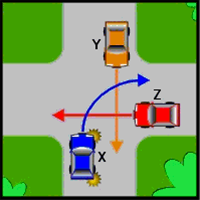
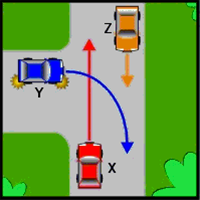
Which of the following statements is correct?
AVehicle X gives way to both Y and Z.
BVehicle Y gives way to both X and Z.
CVehicle Z gives way to both X and Y.
View answer and explanation
Answer: A
Vehicle X is turning right and must give way to the oncoming vehicle Y going straight, as well as vehicle Z approaching from the right.
📖 Reference: 3.13 — Intersections (give way). Give way to all traffic coming from the left or right, including turning vehicles. A vehicle entering a road from a driveway or terminating road must give way to traffic on the continuing road.
Q0279Quiz 10Overtaking · Lanes
Which of the following statements is correct?
AVehicle X must not overtake Y.
BVehicle X may overtake Y, only in a 50km/h area.
CVehicle X may overtake Y.
View answer and explanation
Answer: A
Official answer: Vehicle X must not overtake Y (overtaking is not allowed in this diagram).
📖 Reference: 3.13 — Intersections (give way). Give way to all traffic coming from the left or right, including turning vehicles. A vehicle entering a road from a driveway or terminating road must give way to traffic on the continuing road.
Q0280Quiz 10Speed · Distances
When are you allowed to sound your vehicle's horn?
AOnly when you are travelling outside built-up areas.
BOnly when it is used as a warning device.
CAt any time.
View answer and explanation
Answer: B
The horn is only for use as a warning.
📖 Reference: 1.11 — Pre-Driving Checks (horn). Only use your horn to warn other road users of danger – it is an offence to use it for other purposes.
Q0281Quiz 10Traffic Lights
When approaching traffic lights, what does a green light with a red arrow mean?
AYou may go in any direction other than that indicated by the arrow.
BYou may turn in the direction of the arrow, if it is safe to do so.
CStop, the lights are not working properly.
View answer and explanation
Answer: A
Green light with red arrow: you may go in any direction except the one the arrow points to.
📖 Reference: 3.10.1 — Intersection traffic control signals. Red means STOP. When the light is red, you must wait behind the stop line. A green arrow permits movement in the direction of the arrow; other lights still apply to other directions.
Q0282Quiz 10Give Way · Intersections
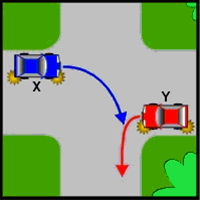
Which vehicle must give way?
AVehicle Y.
BNeither vehicle has to give way.
CVehicle X.
View answer and explanation
Answer: C
📖 Reference: 3.13 — Intersections (give way). Give way to all traffic coming from the left or right, including turning vehicles. A vehicle entering a road from a driveway or terminating road must give way to traffic on the continuing road.
Q0283Quiz 10Alcohol · Drugs
If a vehicle is overtaking you and there is not enough distance for it to complete the manoeuvre safely, what should you do?
ASound your horn to warn of approaching danger.
BSlow down to let the vehicle move in front of you.
CIncrease your speed to make the passing vehicle fall back behind you.
View answer and explanation
Answer: B
When there isn't enough distance to overtake, slow down and yield.
📖 Reference: 3.16 — Overtaking. To overtake safely you must get a good view of the road ahead, check mirrors and blind spots, and only overtake when it is safe. You must not exceed the speed limit to overtake, and you must not overtake unless it can be done safely.
Q0284Quiz 10Lights · Weather
Should you use high beam or low beam when driving in fog or smoke?
AHigh beam.
BIt makes no difference.
CLow beam.
View answer and explanation
Answer: C
Use low-beam headlights in fog or smoke.
📖 Reference: 3.3.1 / 3.3.3 — Driving at night / in fog. Drive with your headlights on between sunset and sunrise. You are legally required to dip your headlights within 200 metres of an approaching vehicle or when driving less than 200 metres behind another vehicle. In fog or smoke, dip your headlights and drive slowly.
Q0285Quiz 10Give Way · Intersections
Which of the following statements is correct?
AVehicle X gives way to both Y and Z.
BVehicle Z gives way to both X and Y.
CVehicle Y gives way to both X and Z.
View answer and explanation
Answer: C
Vehicle Y is at a T-intersection on the terminating road and must give way to all vehicles (X and Z) travelling on the continuing road.
📖 Reference: 3.13 — Intersections (give way). Give way to all traffic coming from the left or right, including turning vehicles. A vehicle entering a road from a driveway or terminating road must give way to traffic on the continuing road.
Q0286Quiz 10Alcohol · Drugs
How do even small amounts of alcohol affect your driving?
ABy making you think you are driving better than you are.
BBy helping your driving ability.
CBy helping your judgement of speed.
View answer and explanation
Answer: A
A small amount of alcohol makes you overestimate your driving ability.
📖 Reference: 1.3.3 / 1.3.4 — Blood alcohol concentration (BAC). All novice drivers are subject to a zero blood alcohol limit (0.00%). The BAC limit for full licence drivers is 0.05%. Alcohol slows down your reaction time to road hazards and gives you a false sense of confidence.
Q0287Quiz 10Pedestrians · Buses
What is the reduced speed limit around schools during certain times of the day?
A50km/h.
B40km/h.
C60km/h.
View answer and explanation
Answer: B
School zone speed limit: 40 km/h.
📖 Reference: 3.1.1 — Speed Limits. In a ‘built-up’ area, the default speed limit is 50 km/h unless a sign shows a different speed. Learner drivers: 100 km/h. Vehicles towing caravans or trailers: 100 km/h. Roadworks: obey the speed limit shown on the sign.
Q0288Quiz 10Pedestrians · Buses
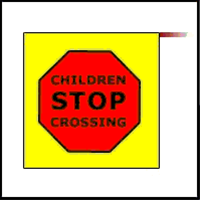
What must you do at a children's crossing when a crossing attendant extends this flag?
AStop and do not proceed until the attendant withdraws the sign.
BSlow down.
CDrive on carefully if no children are on your side of the crossing.
View answer and explanation
Answer: A
When a crossing attendant displays the red "Children Stop Crossing" flag, you must come to a complete stop at the stop line and remain stopped until the attendant removes the sign.
📖 Reference: 1.8.1 — Pedestrians. Always keep a look out for pedestrians and be ready to stop for them. Give way to pedestrians crossing at intersections and at pedestrian/children’s crossings. At children’s crossings you must stop when the crossing attendant extends the flags.
Q0289Quiz 10Traffic Lights
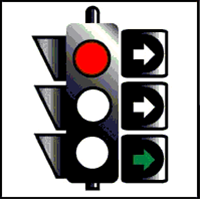
When approaching traffic lights, what does a red light with a green arrow (as shown in the diagram) mean?
AStop, until all lights show green.
BYou may proceed in the direction of the arrow.
CProceed in any direction.
View answer and explanation
Answer: B
A green arrow means you may go in the direction it points, even if the main traffic light is red.
📖 Reference: 3.10.1 — Intersection traffic control signals. Red means STOP. When the light is red, you must wait behind the stop line. A green arrow permits movement in the direction of the arrow; other lights still apply to other directions.
Q0290Quiz 10Overtaking · Lanes
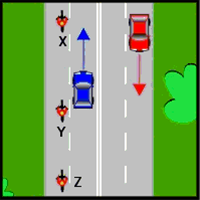
Which motorcycle is in the car driver's blind spot?
AMotorcycle X.
BMotorcycle Y.
CMotorcycle Z.
View answer and explanation
Answer: B
Motorcycle Y is alongside the rear of the car, in the area not covered by the rear-view or side mirrors — the blind spot.
📖 Reference: 1.11 / 3.15 — Blind spots. There are blind spots at the sides and rear of your vehicle that cannot be seen in the mirrors. Check your blind spots by glancing over your shoulder before you move left or right.
Q0291Quiz 10Speed · Distances
Which of the following statements is correct?
AIt is always safe to travel at the speed limit.
BYour travelling speed should be as close to the speed limit as possible.
CTravelling at the speed limit is sometimes too fast for the conditions.
View answer and explanation
Answer: C
Speed limits are sometimes too fast for current conditions.
📖 Reference: 3.13 — Intersections (give way). Give way to all traffic coming from the left or right, including turning vehicles. A vehicle entering a road from a driveway or terminating road must give way to traffic on the continuing road.
Q0292Quiz 10Overtaking · Lanes
Which of the following should you do before overtaking a long vehicle?
AFollow closely behind the vehicle.
BFollow far enough behind the vehicle to have a clear view of the road ahead.
CSound your horn.
View answer and explanation
Answer: B
When overtaking a long vehicle, stay farther back so you can see clearly ahead.
📖 Reference: 3.16 — Overtaking. To overtake safely you must get a good view of the road ahead, check mirrors and blind spots, and only overtake when it is safe. You must not exceed the speed limit to overtake, and you must not overtake unless it can be done safely.
Q0293Quiz 10Markings · Signs
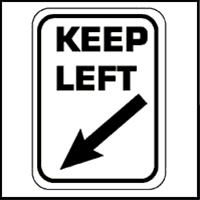
What is the meaning of this sign?
ATurn left at the next street.
BPass on the left of traffic.
CKeep to the left of the sign.
View answer and explanation
Answer: C
This regulatory sign tells drivers they must pass on its left side. It is usually placed on a traffic island or median strip.
📖 Reference: 3.8 — Traffic Signs. Signs are installed along our roads to make them safer for all users. Regulatory signs control traffic and must be obeyed; warning signs (diamond-shaped) alert you to hazards ahead.
Q0294Quiz 10Emergencies · First Aid
What is the first thing you should do when you assist at a crash scene?
ARemove occupants from their vehicle.
BCheck whether anyone injured is unconscious.
CCheck for danger.
View answer and explanation
Answer: C
When you arrive to assist at an accident, first check the scene for any danger.
📖 Reference: 4.3 — First Aid (DRSABCD). Follow the DRSABCD action plan: first check for DANGER before approaching the injured person. The first few minutes after a crash are vital.
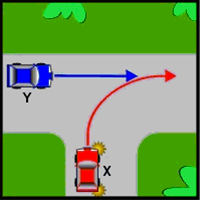
Q0295Quiz 10Give Way · Intersections
Which vehicle must give way?
ANeither vehicle has to give way.
BVehicle X.
CVehicle Y.
View answer and explanation
Answer: B
Vehicle X is turning from the terminating road at a T-intersection and must give way to all vehicles on the continuing road, such as Vehicle Y.
📖 Reference: 3.13 — Intersections (give way). Give way to all traffic coming from the left or right, including turning vehicles. A vehicle entering a road from a driveway or terminating road must give way to traffic on the continuing road.