30 questions · Based on public Transport WA quiz material and the Drive Safe handbook · English explanations and handbook references
Q0091Quiz 4Overtaking · Lanes
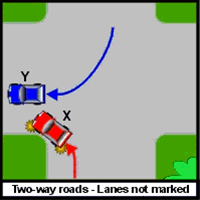
Which of the following statements is correct?
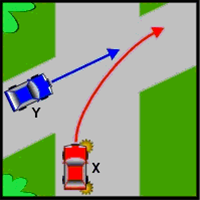
AVehicle X must not overtake Y.
BVehicle X may overtake Y, only in a 50km/h area.
CVehicle X may overtake Y.
View answer and explanation
Answer: A
Official answer: Vehicle X must not overtake Y (overtaking is not allowed in this diagram).
📖 Reference: 3.13 — Intersections (give way). Give way to all traffic coming from the left or right, including turning vehicles. A vehicle entering a road from a driveway or terminating road must give way to traffic on the continuing road.
Q0092Quiz 4Speed · Distances
What is the speed limit in built-up areas where there are no speed limit signs?
A60km/h.
B50km/h.
C80km/h.
View answer and explanation
Answer: B
In built-up areas with no signs, the default speed limit is 50 km/h.
📖 Reference: 3.1.1 — Speed Limits. In a ‘built-up’ area, the default speed limit is 50 km/h unless a sign shows a different speed. Learner drivers: 100 km/h. Vehicles towing caravans or trailers: 100 km/h. Roadworks: obey the speed limit shown on the sign.
Q0093Quiz 4Overtaking · Lanes
For how long must you indicate before you overtake a vehicle?
ALong enough to give other road users sufficient warning of your intention.
BAt least 10 metres.
CAt least 100 metres.
View answer and explanation
Answer: A
Before overtaking, signal for just long enough to alert other road users.
📖 Reference: 3.16 — Overtaking. To overtake safely you must get a good view of the road ahead, check mirrors and blind spots, and only overtake when it is safe. You must not exceed the speed limit to overtake, and you must not overtake unless it can be done safely.
Q0094Quiz 4Mobile · Fatigue
Are you allowed to use a hand-held mobile phone while driving?
ANo.
BYes, providing you do not lose concentration.
CYes.
View answer and explanation
Answer: A
You must not hold a phone while driving.
📖 Reference: 1.7 — Mobile Phones. A mobile phone may only be used by the driver while driving if it is secured in a mounting affixed to the vehicle or can be operated without touching it (voice activated). You must not use a hand-held phone while driving.
Q0095Quiz 4Give Way · Intersections
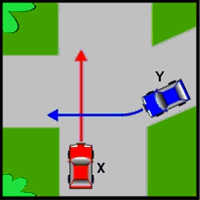
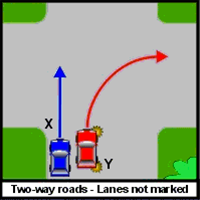
Which vehicle must give way?
AVehicle Y.
BVehicle X.
CNeither vehicle has to give way.
View answer and explanation
Answer: A
The provided text is already in English. For a more natural learner-friendly phrasing: "Vehicle Y is turning right and crossing the path of Vehicle X, which is going straight. So Vehicle Y must give way."
📖 Reference: 3.13 — Intersections (give way). Give way to all traffic coming from the left or right, including turning vehicles. A vehicle entering a road from a driveway or terminating road must give way to traffic on the continuing road.
Q0096Quiz 4Alcohol · Drugs
How do even small amounts of alcohol affect your driving?
ABy making you think you are driving better than you are.
BBy helping your driving ability.
CBy helping your judgement of speed.
View answer and explanation
Answer: A
Even a small amount of alcohol can make you overestimate your driving ability.
📖 Reference: 1.3.3 / 1.3.4 — Blood alcohol concentration (BAC). All novice drivers are subject to a zero blood alcohol limit (0.00%). The BAC limit for full licence drivers is 0.05%. Alcohol slows down your reaction time to road hazards and gives you a false sense of confidence.
Q0097Quiz 4Give Way · Intersections
What is the basic rule that applies to uncontrolled four-way intersections?
AGive way to vehicles on your right.
BGive way to all vehicles.
CGive way to vehicles on your left.
View answer and explanation
Answer: A
Unsignalized four-way intersection: yield to vehicles approaching from the right.
📖 Reference: 3.13.2 — Uncontrolled intersections. At an uncontrolled intersection, give way to vehicles approaching from your right. If you are turning right at any uncontrolled intersection YOU must also give way to oncoming traffic travelling towards you or turning left.
Q0098Quiz 4Pedestrians · Buses
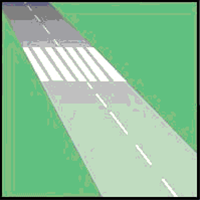
Are you allowed to park a vehicle on a pedestrian crossing?
AYes, if no pedestrians are using it.
BYes, if it is a passenger vehicle.
CNo.
View answer and explanation
Answer: C
Parking or stopping on a pedestrian crossing is illegal because it blocks pedestrians and reduces visibility for other drivers.
📖 Reference: 1.8.1 — Pedestrians. Always keep a look out for pedestrians and be ready to stop for them. Give way to pedestrians crossing at intersections and at pedestrian/children’s crossings. At children’s crossings you must stop when the crossing attendant extends the flags.
Q0099Quiz 4Traffic Lights
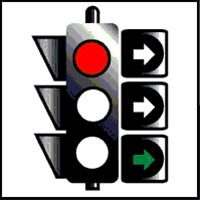
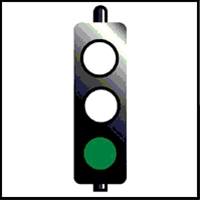
When approaching traffic lights, what does a red light with a green arrow (as shown in the diagram) mean?
AStop, until all lights show green.
BYou may proceed in the direction of the arrow.
CProceed in any direction.
View answer and explanation
Answer: B
A green arrow means you can go in the direction it points, even if the main traffic light is red.
📖 Reference: 3.10.1 — Intersection traffic control signals. Red means STOP. When the light is red, you must wait behind the stop line. A green arrow permits movement in the direction of the arrow; other lights still apply to other directions.
Q0100Quiz 4Give Way · Intersections
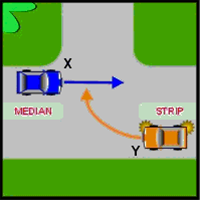
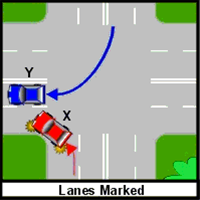
Which vehicle must give way?
AVehicle Y.
BNeither vehicle has to give way.
CVehicle X.
View answer and explanation
Answer: C
Official answer: Vehicle X gives way (confirmed by the official marking).
📖 Reference: 3.13 — Intersections (give way). Give way to all traffic coming from the left or right, including turning vehicles. A vehicle entering a road from a driveway or terminating road must give way to traffic on the continuing road.
Q0101Quiz 4Traffic Lights
If you are turning right at traffic lights and the light is green (as shown in the diagram), what should you do?
ATurn only if you can do so without interfering with other traffic.
BWait until the light changes to red and then turn quickly.
CDo not move until the light changes to yellow and then turn quickly.
View answer and explanation
Answer: A
📖 Reference: 3.10.1 / 3.13.1 — Traffic control signals / Intersections. When turning right at a green light you must give way to oncoming traffic and pedestrians. Green means proceed only if the way is clear.
Q0102Quiz 4Give Way · Intersections
What must you do at a STOP sign?
AStop at least 2 metres before the sign.
BStop and give way to all traffic on the crossroad.
CSlow down and be prepared to stop if any traffic is approaching.
View answer and explanation
Answer: B
STOP sign: come to a complete stop and yield to all vehicles on the cross street.
📖 Reference: 3.13.1 — Controlled intersections. At an intersection controlled by a ‘STOP’ sign, you must stop your vehicle and give way to all traffic travelling along or turning from the intersecting road. If there is no line, stop as close to the intersection as practicable but before entering it.
Q0103Quiz 4Overtaking · Lanes
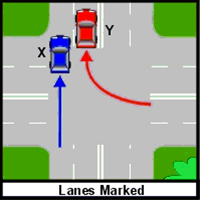
Which of the following statements is correct?
AVehicle X may overtake Y, only in a 60km/h area.
BVehicle X must not overtake Y.
CVehicle X may overtake Y.
View answer and explanation
Answer: C
The provided text is already in English. A slightly more natural version: “You may overtake on the left if the vehicle ahead is turning right and there is a marked lane to pass in.”
📖 Reference: 3.13 — Intersections (give way). Give way to all traffic coming from the left or right, including turning vehicles. A vehicle entering a road from a driveway or terminating road must give way to traffic on the continuing road.
Q0104Quiz 4Seatbelts · Vehicle
Which of the following statements is correct?
APassengers in vehicles are less likely to be injured in a crash if they are wearing seat belts.
BThe nature of injuries in motor vehicle crashes is not related to the wearing of seat belts.
CPassengers in rear seats of a vehicle are not required to wear seat belts.
View answer and explanation
Answer: A
Wearing your seatbelt reduces the risk of injury—and rear-seat passengers must wear theirs too.
📖 Reference: 3.13 — Intersections (give way). Give way to all traffic coming from the left or right, including turning vehicles. A vehicle entering a road from a driveway or terminating road must give way to traffic on the continuing road.
Q0105Quiz 4Pedestrians · Buses
What is the minimum distance a vehicle is allowed to park before a bus stop or pedestrian crossing?
A20 metres.
B3 metres.
C6 metres.
View answer and explanation
Answer: A
No parking within 20 meters before a bus stop or pedestrian crossing.
📖 Reference: 3.6 — Buses and Taxis. You must give way to a bus moving out from a bus stop in a ‘built-up’ area providing the bus is indicating and has a ‘GIVE WAY’ sign displayed on the back.
Q0106Quiz 4Alcohol · Drugs
Are passengers allowed to travel in the back of a utility or in an open load space?
AYes, if the vehicle does not exceed 60km/h.
BYes, providing they are seated.
CNo.
View answer and explanation
Answer: C
Passengers are not allowed in the cargo bed of a pickup truck.
📖 Reference: 1.4 / 5.4 — Regulations for your car. Passengers are not allowed to travel in the back of a utility or in an open load space. All occupants must be appropriately restrained.
Q0107Quiz 4Give Way · Intersections
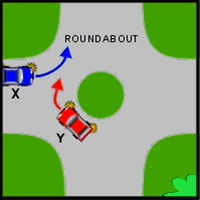
Which vehicle must give way?
ANeither vehicle has to give way.
BVehicle Y.
CVehicle X.
View answer and explanation
Answer: C
At a roundabout, you must give way to all vehicles on your right, so Vehicle X must give way to Vehicle Y, which is approaching from the right.
📖 Reference: 3.13 — Intersections (give way). Give way to all traffic coming from the left or right, including turning vehicles. A vehicle entering a road from a driveway or terminating road must give way to traffic on the continuing road.
Q0108Quiz 4Alcohol · Drugs
What is the legal blood alcohol concentration (BAC) for drivers with a full licence?
ALess than 0.02%.
BLess than 0.05%.
CLess than 0.08%.
View answer and explanation
Answer: B
For a full driving license, the legal BAC limit is less than 0.05%.
📖 Reference: 1.3.3 / 1.3.4 — Blood alcohol concentration (BAC). All novice drivers are subject to a zero blood alcohol limit (0.00%). The BAC limit for full licence drivers is 0.05%. Alcohol slows down your reaction time to road hazards and gives you a false sense of confidence.
Q0109Quiz 4Give Way · Intersections
Which vehicle must give way?
ANeither vehicle has to give way.
BVehicle Y.
CVehicle X.
View answer and explanation
Answer: B
Official answer: Vehicle Y gives way (confirmed by official marking).
📖 Reference: 3.13 — Intersections (give way). Give way to all traffic coming from the left or right, including turning vehicles. A vehicle entering a road from a driveway or terminating road must give way to traffic on the continuing road.
Q0110Quiz 4Traffic Lights
What is the minimum distance a vehicle is allowed to park from an intersection without traffic lights?
A3 metres.
B10 metres.
C1 metre.
View answer and explanation
Answer: B
Parking is prohibited within 10 meters of an intersection without traffic lights.
📖 Reference: 3.17 — Stopping. You must not stop: within 10 metres of an intersection; within 20 metres of the approach side and 10 metres of the leaving side of a pedestrian/children’s crossing or bus stop; within one metre of a fire hydrant; within 20 metres of a railway crossing; within 3 metres of a letter box; or on a footpath.
Q0111Quiz 4Overtaking · Lanes
Which of the following statements is correct?
AVehicle X may overtake Y, only in a 60km/h area.
BVehicle X may overtake Y.
CVehicle X must not overtake Y.
View answer and explanation
Answer: B
Official answer: Vehicle X may overtake Y (official marking confirms this).
📖 Reference: 3.13 — Intersections (give way). Give way to all traffic coming from the left or right, including turning vehicles. A vehicle entering a road from a driveway or terminating road must give way to traffic on the continuing road.
Q0112Quiz 4Speed · Distances
What is the safest way to approach an intersection?
ATravelling at the speed limit for the area.
BTravelling at a speed that will allow you to stop if required.
CLooking steadily to the right.
View answer and explanation
Answer: B
Approaching an intersection: your speed should let you stop at any moment.
📖 Reference: 3.13 — Intersections. Approach intersections at a speed that will allow you to stop if required. Always be prepared to stop and look out for other vehicles and pedestrians.
Q0113Quiz 4Speed · Distances
What is the maximum speed learner drivers (L-plates) are allowed to travel?
A110km/h.
B90km/h.
C100km/h.
View answer and explanation
Answer: C
L-plate learners are subject to a 100 km/h speed limit.
📖 Reference: 3.1.1 — Speed Limits. In a ‘built-up’ area, the default speed limit is 50 km/h unless a sign shows a different speed. Learner drivers: 100 km/h. Vehicles towing caravans or trailers: 100 km/h. Roadworks: obey the speed limit shown on the sign.
Q0114Quiz 4Turning · U-turns
How long must you indicate before you turn left or right for?
AAt least 70 metres before the turn.
BLong enough to give sufficient warning to other road users before you turn.
CAt least 10 metres before the turn.
View answer and explanation
Answer: B
Signal before turning: just enough to alert other road users.
📖 Reference: 3.14.3 — ‘U’ turns. You must not make a ‘U’ turn: unless the turn can be made safely; if there is a ‘NO U TURN’ sign; at traffic control signals (unless there is a ‘U TURN PERMITTED’ sign); or on a freeway.
Q0115Quiz 4Alcohol · Drugs
What is the minimum penalty for a provisional driver with a BAC over 0.00%?
AA fine.
BA fine and accrual of demerit points.
CA fine and loss of licence.
View answer and explanation
Answer: B
Official answer: fine + demerit points. For a provisional licence, a BAC over 0.00% carries a minimum penalty that includes demerit points.
📖 Reference: 1.3.3 / 1.3.4 — Blood alcohol concentration (BAC). All novice drivers are subject to a zero blood alcohol limit (0.00%). The BAC limit for full licence drivers is 0.05%. Alcohol slows down your reaction time to road hazards and gives you a false sense of confidence.
Q0116Quiz 4Lights · Weather
Should you use high beam or low beam when driving in fog or smoke?
AHigh beam.
BIt makes no difference.
CLow beam.
View answer and explanation
Answer: C
Use low beams in fog or smoke.
📖 Reference: 3.3.1 / 3.3.3 — Driving at night / in fog. Drive with your headlights on between sunset and sunrise. You are legally required to dip your headlights within 200 metres of an approaching vehicle or when driving less than 200 metres behind another vehicle. In fog or smoke, dip your headlights and drive slowly.
Q0117Quiz 4Pedestrians · Buses
What should you do when approaching a pedestrian crossing area?
AEase your way through the pedestrians.
BSound your horn to warn pedestrians of your approach.
CSlow down and be prepared to stop.
View answer and explanation
Answer: C
Approaching a pedestrian crossing: slow down and be ready to stop.
📖 Reference: 1.8.1 — Pedestrians. Always keep a look out for pedestrians and be ready to stop for them. Give way to pedestrians crossing at intersections and at pedestrian/children’s crossings. At children’s crossings you must stop when the crossing attendant extends the flags.
Q0118Quiz 4Emergencies · First Aid
What should you do if your accelerator is stuck?
AApply the clutch or select neutral and apply the brake to stop.
BSwitch off the ignition.
CChange to a lower gear.
View answer and explanation
Answer: A
If the accelerator is stuck: press the clutch or shift to neutral, then brake to stop.
📖 Reference: 4.2.3 — A stuck accelerator. If your accelerator is stuck: depress the clutch or select ‘NEUTRAL’, apply firm pressure on the brakes without locking the wheels, and pull off the road safely.
Q0119Quiz 4Give Way · Intersections
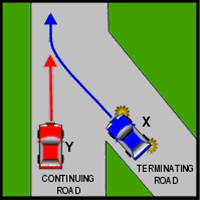
Which vehicle must give way?
AVehicle Y.
BVehicle X.
CNeither vehicle has to give way.
View answer and explanation
Answer: B
Vehicle X is on a terminating road and must give way to all vehicles on the continuing road, which includes Vehicle Y.
📖 Reference: 3.13 — Intersections (give way). Give way to all traffic coming from the left or right, including turning vehicles. A vehicle entering a road from a driveway or terminating road must give way to traffic on the continuing road.
Q0120Quiz 4Overtaking · Lanes
Which of the following statements is correct?
AVehicle X may overtake Y.
BVehicle X must not overtake Y.
CVehicle X may overtake Y, only in a 50km/h area.
View answer and explanation
Answer: A
You may overtake on the left if the vehicle ahead is turning right.
📖 Reference: 3.13 — Intersections (give way). Give way to all traffic coming from the left or right, including turning vehicles. A vehicle entering a road from a driveway or terminating road must give way to traffic on the continuing road.