30 questions · Based on public Transport WA quiz material and the Drive Safe handbook · English explanations and handbook references
Q0031Quiz 2Pedestrians · Buses
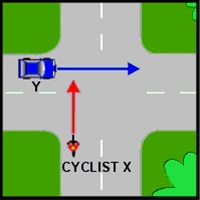
Who must give way?
AVehicle Y.
BNeither has to give way.
CThe cyclist X.
View answer and explanation
Answer: A
At an intersection with give-way lines (or an uncontrolled intersection), you must give way to vehicles approaching from your right. In this case, the cyclist is approaching from Vehicle Y's right, so Vehicle Y must give way.
📖 Reference: 3.13 — Intersections (give way). Give way to all traffic coming from the left or right, including turning vehicles. A vehicle entering a road from a driveway or terminating road must give way to traffic on the continuing road.
Q0032Quiz 2Lights · Weather
When should you switch your headlights on?
A20 minutes after sunset.
B15 minutes after sunset.
CAt sunset.
View answer and explanation
Answer: C
Turn on your headlights at sunset (meaning switch them on at dusk, not 15/20 minutes after sunset).
📖 Reference: 3.3.1 / 3.3.3 — Driving at night / in fog. Drive with your headlights on between sunset and sunrise. You are legally required to dip your headlights within 200 metres of an approaching vehicle or when driving less than 200 metres behind another vehicle. In fog or smoke, dip your headlights and drive slowly.
Q0033Quiz 2Give Way · Intersections
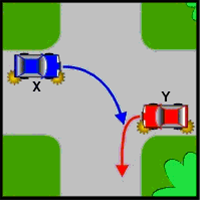
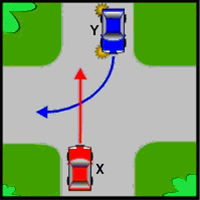
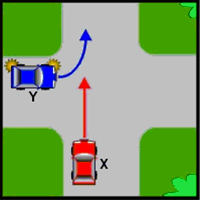
Which vehicle must give way?
AVehicle Y.
BNeither vehicle has to give way.
CVehicle X.
View answer and explanation
Answer: C
Vehicle X is turning right at the intersection and must give way to oncoming Vehicle Y, which is turning left into the same road.
📖 Reference: 3.13 — Intersections (give way). Give way to all traffic coming from the left or right, including turning vehicles. A vehicle entering a road from a driveway or terminating road must give way to traffic on the continuing road.
Q0034Quiz 2Traffic Lights
Are you allowed to make a 'U' turn at traffic lights?
AYes.
BNo, unless there is a 'U' TURN PERMITTED sign.
CYes, if the traffic lights are not working.
View answer and explanation
Answer: B
At intersections with traffic lights, U-turns are prohibited unless there is a “U TURN PERMITTED” sign.
📖 Reference: 3.14.3 — ‘U’ turns. You must not make a ‘U’ turn at traffic control signals unless there is a ‘U TURN PERMITTED’ sign.
Q0035Quiz 2Alcohol · Drugs
How do even small amounts of alcohol affect your driving?
ABy making you think you are driving better than you are.
BBy helping your driving ability.
CBy helping your judgement of speed.
View answer and explanation
Answer: A
A small amount of alcohol can make you overestimate your driving ability—and that's the most dangerous part.
📖 Reference: 1.3.3 / 1.3.4 — Blood alcohol concentration (BAC). All novice drivers are subject to a zero blood alcohol limit (0.00%). The BAC limit for full licence drivers is 0.05%. Alcohol slows down your reaction time to road hazards and gives you a false sense of confidence.
Q0036Quiz 2Give Way · Intersections
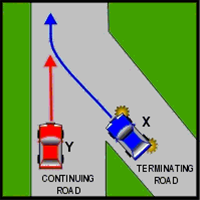
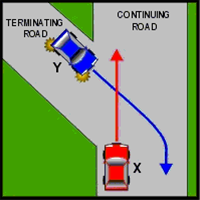
Which vehicle must give way?
AVehicle Y.
BVehicle X.
CNeither vehicle has to give way.
View answer and explanation
Answer: B
Vehicle X is on a terminating road, so it must give way to all vehicles on the continuing road.
📖 Reference: 3.13 — Intersections (give way). Give way to all traffic coming from the left or right, including turning vehicles. A vehicle entering a road from a driveway or terminating road must give way to traffic on the continuing road.
Q0037Quiz 2Emergencies · First Aid
What should you do if a head-on collision seems likely?
AApply your emergency brake.
BBrake firmly and drive towards open ground.
CSwitch off the ignition.
View answer and explanation
Answer: B
If a head-on collision seems possible: brake hard and steer toward an open area to avoid crashing into the oncoming vehicle.
📖 Reference: 4.2.5 — Possible head-on collision. If a head-on collision seems likely: brake firmly without skidding, give the oncoming vehicle all the room you can, and look for an avenue of escape.
Q0038Quiz 2Railway Crossings
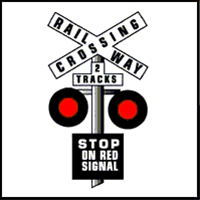
What do red flashing lights mean at a railway crossing (as shown in the diagram)?
AStop, only if you see a train approaching.
BStop before the crossing and remain stationary until the lights stop flashing.
CSlow down and proceed with caution.
View answer and explanation
Answer: B
Red flashing lights at a railway crossing mean a train is approaching, so you must stop before the crossing and wait until the lights stop flashing.
📖 Reference: 3.5 — Railway Crossings. You must stop if warning bells or flashing red lights are operating, boom gates are down, or a train is coming. You may drive on only when it is safe and no train is approaching; if lights are still flashing you must not cross.
Q0039Quiz 2Speed · Distances
Which of the following statements is correct?
AIt is always safe to travel at the speed limit.
BYour travelling speed should be as close to the speed limit as possible.
CTravelling at the speed limit is sometimes too fast for the conditions.
View answer and explanation
Answer: C
The speed limit is a maximum, not a target; in poor conditions, even the limit can be too fast.
📖 Reference: 3.13 — Intersections (give way). Give way to all traffic coming from the left or right, including turning vehicles. A vehicle entering a road from a driveway or terminating road must give way to traffic on the continuing road.
Q0040Quiz 2Railway Crossings
What should you do when approaching a railway crossing?
ASpeed up to clear the crossing quickly.
BSlow down and be prepared to stop.
CSound your horn.
View answer and explanation
Answer: B
When approaching a railway crossing, slow down and be prepared to stop.
📖 Reference: 3.5 — Railway Crossings. You must stop if warning bells or flashing red lights are operating, boom gates are down, or a train is coming. You may drive on only when it is safe and no train is approaching; if lights are still flashing you must not cross.
Q0041Quiz 2Stopping · Parking
What is the minimum distance a vehicle is allowed to park from a fire hydrant?
A3 metres.
B1 metre.
C5 metres.
View answer and explanation
Answer: B
No parking within 1 metre of a fire hydrant (handbook 3.17 original text: "within one metre of a fire hydrant").
📖 Reference: 3.17 — Stopping. You must not stop: within 10 metres of an intersection; within 20 metres of the approach side and 10 metres of the leaving side of a pedestrian/children’s crossing or bus stop; within one metre of a fire hydrant; within 20 metres of a railway crossing; within 3 metres of a letter box; or on a footpath.
Q0042Quiz 2Overtaking · Lanes
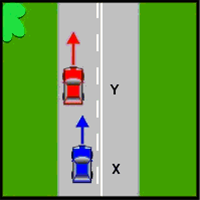
Is vehicle X allowed to overtake vehicle Y?
ANo.
BYes, if it is safe to do so.
CIt depends on the weather conditions.
View answer and explanation
Answer: B
📖 Reference: 3.16 — Overtaking. To overtake safely you must get a good view of the road ahead, check mirrors and blind spots, and only overtake when it is safe. You must not exceed the speed limit to overtake, and you must not overtake unless it can be done safely.
Q0043Quiz 2Markings · Signs
Is a vehicle allowed to cross over a double unbroken white line (as shown in the diagram)?
AYes, if the driver wishes to overtake another vehicle.
BNo.
CYes, if the driver wishes to make a right-hand turn or a 'U' turn and it is safe and legal to do so.
View answer and explanation
Answer: C
The text you provided is already in English, not Chinese—so there’s nothing to translate. If you did mean to share the original Chinese, please paste it and I’ll translate it for you. In the meantime, here’s a more natural English version for a learner-driver app:
In Western Australia, you must not cross double unbroken white lines to overtake. However, you are allowed to cross them to make a right-hand turn, do a U-turn, or enter/leave the road, as long as it is safe and legal.
📖 Reference: 3.9 — Road Markings. Broken white lines (dashed) separate lanes and may be crossed to overtake or turn right when it is safe to do so.
Q0044Quiz 2Give Way · Intersections
Which vehicle must give way?
ANeither vehicle has to give way.
BVehicle X.
CVehicle Y.
View answer and explanation
Answer: C
The provided text is already in English. Here is a natural, concise version for a learner-driver app:
Vehicle Y is turning right across the path of Vehicle X, which is going straight. Therefore, Vehicle Y must yield to the oncoming vehicle.
📖 Reference: 3.13 — Intersections (give way). Give way to all traffic coming from the left or right, including turning vehicles. A vehicle entering a road from a driveway or terminating road must give way to traffic on the continuing road.
Q0045Quiz 2Speed · Distances
What should you do when a driver is indicating to overtake you?
ASpeed up if you are travelling under the speed limit.
BMove as far to the left as possible and do not increase your speed.
CSignal the driver to remain behind you if you think he or she is travelling too fast.
View answer and explanation
Answer: B
When being overtaken: stay as far left as possible and do not accelerate.
📖 Reference: 3.16 — Overtaking. To overtake safely you must get a good view of the road ahead, check mirrors and blind spots, and only overtake when it is safe. You must not exceed the speed limit to overtake, and you must not overtake unless it can be done safely.
Q0046Quiz 2Stopping · Parking
What is the minimum distance a vehicle is allowed to park from a public letter box?
A3 metres.
B5 metres.
C1 metres.
View answer and explanation
Answer: A
Parking is prohibited within 3 meters of a public mailbox.
📖 Reference: 3.17 — Stopping. You must not stop: within 10 metres of an intersection; within 20 metres of the approach side and 10 metres of the leaving side of a pedestrian/children’s crossing or bus stop; within one metre of a fire hydrant; within 20 metres of a railway crossing; within 3 metres of a letter box; or on a footpath.
Q0047Quiz 2Alcohol · Drugs
If a vehicle is overtaking you and there is not enough distance for it to complete the manoeuvre safely, what should you do?
ASound your horn to warn of approaching danger.
BSlow down to let the vehicle move in front of you.
CIncrease your speed to make the passing vehicle fall back behind you.
View answer and explanation
Answer: B
When another driver doesn't have enough room to overtake, slow down to let them merge in ahead—do not speed up.
📖 Reference: 3.16 — Overtaking. To overtake safely you must get a good view of the road ahead, check mirrors and blind spots, and only overtake when it is safe. You must not exceed the speed limit to overtake, and you must not overtake unless it can be done safely.
Q0048Quiz 2Seatbelts · Vehicle
Who will be fined if a passenger under the age of 16 is not wearing a seat belt or suitable child restraint?
AThe owner of the vehicle.
BThe passenger.
CThe driver of the vehicle.
View answer and explanation
Answer: C
If a passenger under 16 is not wearing a seatbelt, the driver is penalized.
📖 Reference: 1.4.4 — Who must wear a seat belt?. The driver and each passenger must be appropriately restrained and in a seated position. Seat belts must be worn by pregnant women. Children under 7 years must wear a suitable child restraint. You do not have to wear a seat belt when reversing.
Q0049Quiz 2Seatbelts · Vehicle
At what age does a person have to wear a seat belt or suitable child restraint?
AAll ages.
BAge 1 year and over.
CAge 8 years and over.
View answer and explanation
Answer: A
All ages must wear seat belts (young children in child restraint devices).
📖 Reference: 1.4.4 — Who must wear a seat belt?. The driver and each passenger must be appropriately restrained and in a seated position. Seat belts must be worn by pregnant women. Children under 7 years must wear a suitable child restraint. You do not have to wear a seat belt when reversing.
Q0050Quiz 2Turning · U-turns
Do you need to indicate if you are turning from a one-way street into another one-way street?
AYes.
BYes, only if there is a vehicle behind you.
CNo.
View answer and explanation
Answer: A
You must use your turn signal for any turn, including turning from a one-way street onto another one-way street.
📖 Reference: 3.11 — Indicators and Hand Signals. Indicate/signal for a sufficient distance prior to turning or diverging to warn other drivers and pedestrians of your intentions. You must indicate whenever you intend to turn, change lanes or diverge.
Q0051Quiz 2Give Way · Intersections
Which vehicle must give way?
ANeither vehicle has to give way.
BVehicle X.
CVehicle Y.
View answer and explanation
Answer: C
Vehicle Y is on the terminating road and must give way to all vehicles on the continuing road, including Vehicle X.
📖 Reference: 3.13 — Intersections (give way). Give way to all traffic coming from the left or right, including turning vehicles. A vehicle entering a road from a driveway or terminating road must give way to traffic on the continuing road.
Q0052Quiz 2Give Way · Intersections
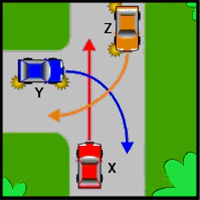
Which of the following statements is correct?
AVehicle Y gives way to both X and Z.
BVehicle X gives way to both Y and Z
CVehicle Z gives way to both X and Y.
View answer and explanation
Answer: A
Vehicle Y is on the road that ends at the T-junction, so it must give way to all vehicles (X and Z) traveling on the through road.
📖 Reference: 3.13 — Intersections (give way). Give way to all traffic coming from the left or right, including turning vehicles. A vehicle entering a road from a driveway or terminating road must give way to traffic on the continuing road.
Q0053Quiz 2Give Way · Intersections
Which vehicle must give way?
ANeither vehicle has to give way.
BVehicle Y.
CVehicle X.
View answer and explanation
Answer: B
At an intersection with no traffic lights or signs, you must give way to any vehicle approaching from your right. Here, Vehicle X is on the right of Vehicle Y.
📖 Reference: 3.13 — Intersections (give way). Give way to all traffic coming from the left or right, including turning vehicles. A vehicle entering a road from a driveway or terminating road must give way to traffic on the continuing road.
Q0054Quiz 2Alcohol · Drugs
Does drinking alcohol and driving increase the risk of having a crash?
AYes.
BNo.
CNo, providing you drink coffee before you drive.
View answer and explanation
Answer: A
Drunk driving increases the risk of accidents.
📖 Reference: 1.3.3 / 1.3.4 — Blood alcohol concentration (BAC). All novice drivers are subject to a zero blood alcohol limit (0.00%). The BAC limit for full licence drivers is 0.05%. Alcohol slows down your reaction time to road hazards and gives you a false sense of confidence.
Q0055Quiz 2Stopping · Parking
How should you park a vehicle on a two-way street when there are no marked parking bays?
AWith the left-hand wheels touching the kerb.
BParallel and close to the left-hand kerb.
CAt least 1 metre from the kerb.
View answer and explanation
Answer: B
Two-way street without parking bay markings: park parallel and close to the left kerb.
📖 Reference: 3.18 — Parking. When parking in a two-way street, you must park close to, and parallel with, the left boundary of the street. Always apply the park brake, remove the ignition key and lock the doors.
Q0056Quiz 2Speed · Distances
What is the maximum speed learner drivers (L-plates) are allowed to travel?
A110km/h.
B90km/h.
C100km/h.
View answer and explanation
Answer: C
L-plate learners have a maximum speed limit of 100 km/h.
📖 Reference: 3.1.1 — Speed Limits. In a ‘built-up’ area, the default speed limit is 50 km/h unless a sign shows a different speed. Learner drivers: 100 km/h. Vehicles towing caravans or trailers: 100 km/h. Roadworks: obey the speed limit shown on the sign.
Q0057Quiz 2Overtaking · Lanes
Do you need to indicate if you overtake a vehicle on an unmarked two-way road?
AYes, only if there is a vehicle behind you.
BNo.
CYes
View answer and explanation
Answer: C
You must use your turn signal when overtaking on a two-way road without lane markings.
📖 Reference: 3.16 — Overtaking. To overtake safely you must get a good view of the road ahead, check mirrors and blind spots, and only overtake when it is safe. You must not exceed the speed limit to overtake, and you must not overtake unless it can be done safely.
Q0058Quiz 2Seatbelts · Vehicle
Which of the following statements is correct?
ATyres with no tread are just as safe as tyres with tread as long as the tyre pressure is correct.
BTyre pressure should be checked when the tyres are hot.
CTyre tread must be at least 1.5mm deep over all parts of the tyre that normally come in contact with the road.
View answer and explanation
Answer: C
Tire tread depth must be at least 1.5mm.
📖 Reference: 3.13 — Intersections (give way). Give way to all traffic coming from the left or right, including turning vehicles. A vehicle entering a road from a driveway or terminating road must give way to traffic on the continuing road.
Q0059Quiz 2Alcohol · Drugs
What is the legal blood alcohol concentration (BAC) for novice drivers?
A0.00%.
B0.02%.
C0.05%.
View answer and explanation
Answer: A
The legal BAC for novice drivers is 0.00%.
📖 Reference: 1.3.3 / 1.3.4 — Blood alcohol concentration (BAC). All novice drivers are subject to a zero blood alcohol limit (0.00%). The BAC limit for full licence drivers is 0.05%. Alcohol slows down your reaction time to road hazards and gives you a false sense of confidence.
Q0060Quiz 2Pedestrians · Buses
What should you do if you see animals on the road ahead?
ASlow down and be prepared to stop.
BSound your horn.
CSpeed up to get past them quickly.
View answer and explanation
Answer: A
Animals on the road: slow down and be prepared to stop.
📖 Reference: 5.8 — Horse and Animal Traffic. If you see livestock on the road ahead, slow down and be prepared to stop. Do not sound your horn or accelerate as this may frighten the animal.