29 questions · Based on public Transport WA quiz material and the Drive Safe handbook · English explanations and handbook references
Q0150Quiz 6Speed · Distances
Which of the following is greater?
AYour braking distance.
BYour stopping distance.
CYour reaction distance.
View answer and explanation
Answer: B
Stopping distance = thinking distance + braking distance, so it’s the longest.
📖 Reference: 3.2.2 — How long does it take to stop your car?. Stopping distance is the total of reaction distance plus braking distance – it is always the greatest of the three.
Q0151Quiz 6Pedestrians · Buses
What is the reduced speed limit around schools during certain times of the day?
A50km/h.
B40km/h.
C60km/h.
View answer and explanation
Answer: B
In school zones, the speed limit is 40 km/h during the designated times.
📖 Reference: 3.1.1 — Speed Limits. In a ‘built-up’ area, the default speed limit is 50 km/h unless a sign shows a different speed. Learner drivers: 100 km/h. Vehicles towing caravans or trailers: 100 km/h. Roadworks: obey the speed limit shown on the sign.
Q0152Quiz 6Seatbelts · Vehicle
At what age does a person have to wear a seat belt or suitable child restraint?
AAll ages.
BAge 1 year and over.
CAge 8 years and over.
View answer and explanation
Answer: A
All ages must wear seat belts.
📖 Reference: 1.4.4 — Who must wear a seat belt?. The driver and each passenger must be appropriately restrained and in a seated position. Seat belts must be worn by pregnant women. Children under 7 years must wear a suitable child restraint. You do not have to wear a seat belt when reversing.
Q0153Quiz 6Give Way · Intersections
Which vehicle must give way?
AVehicle X.
BNeither vehicle has to give way.
CVehicle Y.
View answer and explanation
Answer: C
At an intersection with no traffic lights or signs, you must give way to any vehicle approaching from your right. In this case, Vehicle X is approaching from the right of Vehicle Y.
📖 Reference: 3.13 — Intersections (give way). Give way to all traffic coming from the left or right, including turning vehicles. A vehicle entering a road from a driveway or terminating road must give way to traffic on the continuing road.
Q0154Quiz 6Give Way · Intersections
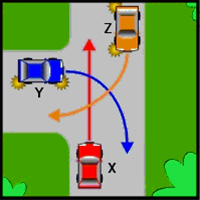
Which of the following statements is correct?
AVehicle Y gives way to both X and Z.
BVehicle X gives way to both Y and Z.
CVehicle Z gives way to both X and Y.
View answer and explanation
Answer: A
Vehicle Y is on the terminating road of a T-intersection and must give way to all vehicles (X and Z) travelling on the continuing road.
📖 Reference: 3.13 — Intersections (give way). Give way to all traffic coming from the left or right, including turning vehicles. A vehicle entering a road from a driveway or terminating road must give way to traffic on the continuing road.
Q0155Quiz 6Give Way · Intersections
Which of the following statements is correct?
AAlcohol has no effect on your driving ability.
BAlcohol makes you react faster to hazards.
CAlcohol makes you react more slowly to hazards.
View answer and explanation
Answer: C
Alcohol slows your reaction time.
📖 Reference: 3.13 — Intersections (give way). Give way to all traffic coming from the left or right, including turning vehicles. A vehicle entering a road from a driveway or terminating road must give way to traffic on the continuing road.
Q0156Quiz 6Pedestrians · Buses
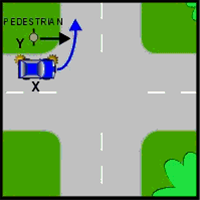
Who must give way?
AThe pedestrian Y.
BVehicle X.
CNeither has to give way.
View answer and explanation
Answer: B
📖 Reference: 3.13 — Intersections (give way). Give way to all traffic coming from the left or right, including turning vehicles. A vehicle entering a road from a driveway or terminating road must give way to traffic on the continuing road.
Q0157Quiz 6Emergencies · First Aid
What should you do if your brakes fail while you are driving?
AChange to a lower gear and gently apply the handbrake.
BSwitch off the ignition.
CAccelerate and sound your horn.
View answer and explanation
Answer: A
Brake failure: downshift and gently pull the handbrake.
📖 Reference: 4.2.4 — Brake failure. If your brakes fail: pump the brake pedal hard and fast, move to a lower gear, gently apply the park brake, and move to the side of the road.
Q0158Quiz 6Traffic Lights
Are you allowed to make a 'U' turn at traffic lights?
AYes.
BNo, unless there is a 'U' TURN PERMITTED sign.
CYes, if the traffic lights are not working.
View answer and explanation
Answer: B
At traffic light intersections, U-turns are prohibited unless a sign specifically allows them.
📖 Reference: 3.14.3 — ‘U’ turns. You must not make a ‘U’ turn at traffic control signals unless there is a ‘U TURN PERMITTED’ sign.
Q0159Quiz 6Traffic Lights
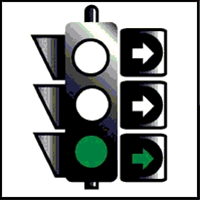
When approaching traffic lights, what does a green light with a green arrow (as shown in the diagram) mean?
AYou may turn right only.
BYou may turn right or drive straight ahead.
CYou may drive straight ahead only.
View answer and explanation
Answer: B
A green circular light means you may drive straight ahead, and a green arrow means you may turn in the direction of the arrow, so both of these actions are allowed.
📖 Reference: 3.10.1 — Intersection traffic control signals. Red means STOP. When the light is red, you must wait behind the stop line. A green arrow permits movement in the direction of the arrow; other lights still apply to other directions.
Q0160Quiz 6Turning · U-turns
On an unmarked road, what position must your vehicle be if you are not preparing to turn or overtake?
AAny position, providing there is no traffic.
BNear the centre of the road.
CClose to the left-hand side of the road.
View answer and explanation
Answer: C
On unmarked roads, when not turning or overtaking, keep to the left.
📖 Reference: 3.14.2 / 3.4 — Turning / Keeping to the Left. When turning left you must move close to the left side of the road. When lanes are not marked, before turning right move as close as possible to the left of the centre of the road. If not preparing to turn, keep as far to the left of the road as practicable.
Q0161Quiz 6Overtaking · Lanes
Which of the following should you do before overtaking a long vehicle?
AFollow closely behind the vehicle.
BFollow far enough behind the vehicle to have a clear view of the road ahead.
CSound your horn.
View answer and explanation
Answer: B
When overtaking a long vehicle, keep enough distance behind it so you can see the road ahead.
📖 Reference: 3.16 — Overtaking. To overtake safely you must get a good view of the road ahead, check mirrors and blind spots, and only overtake when it is safe. You must not exceed the speed limit to overtake, and you must not overtake unless it can be done safely.
Q0162Quiz 6Alcohol · Drugs
Does drinking alcohol and driving increase the risk of having a crash?
AYes.
BNo.
CNo, providing you drink coffee before you drive.
View answer and explanation
Answer: A
Driving after drinking increases the risk of accidents.
📖 Reference: 1.3.3 / 1.3.4 — Blood alcohol concentration (BAC). All novice drivers are subject to a zero blood alcohol limit (0.00%). The BAC limit for full licence drivers is 0.05%. Alcohol slows down your reaction time to road hazards and gives you a false sense of confidence.
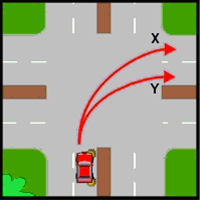
Q0163Quiz 6Turning · U-turns
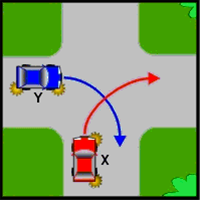
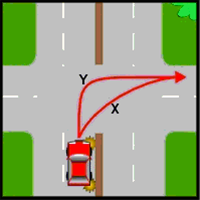
Which is the correct path for the vehicle to take when turning right at an intersection?
AX is the correct path.
BY is the correct path.
CBoth paths are correct.
View answer and explanation
Answer: A
Official answer: X is the correct path (the correct path when turning right).
📖 Reference: 3.14.2 — Turning. When turning right you must: indicate/signal before you turn; when lanes are not marked, move as close as possible to the left of the centre of the road and turn to the right of the centre of the intersection; give way to pedestrians.
Q0164Quiz 6Speed · Distances
What is the maximum speed vehicles towing a caravan or trailer are allowed to travel?
A110km/h.
B90km/h.
C100km/h.
View answer and explanation
Answer: C
Towed caravans have a speed limit of 100 km/h.
📖 Reference: 3.1.1 — Speed Limits. In a ‘built-up’ area, the default speed limit is 50 km/h unless a sign shows a different speed. Learner drivers: 100 km/h. Vehicles towing caravans or trailers: 100 km/h. Roadworks: obey the speed limit shown on the sign.
Q0165Quiz 6Seatbelts · Vehicle
When is a driver allowed to drive without a seat belt?
AWhen reversing a vehicle.
BWhen aged 65 years and over.
CWhen the driver is pregnant.
View answer and explanation
Answer: A
You may temporarily not wear your seatbelt while reversing.
📖 Reference: 1.4.4 — Who must wear a seat belt?. The driver and each passenger must be appropriately restrained and in a seated position. Seat belts must be worn by pregnant women. Children under 7 years must wear a suitable child restraint. You do not have to wear a seat belt when reversing.
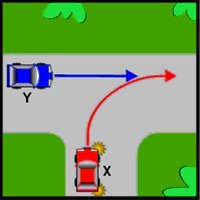
Q0166Quiz 6Give Way · Intersections
Which vehicle must give way?
ANeither vehicle has to give way.
BVehicle X.
CVehicle Y.
View answer and explanation
Answer: B
Vehicle X is at a T-intersection and must give way to all vehicles traveling on the continuing road, including Vehicle Y.
📖 Reference: 3.13 — Intersections (give way). Give way to all traffic coming from the left or right, including turning vehicles. A vehicle entering a road from a driveway or terminating road must give way to traffic on the continuing road.
Q0167Quiz 6Traffic Lights
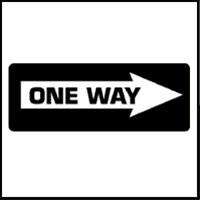
What is the meaning of this sign?
AYou can only drive in the direction of the arrow.
BYou cannot go past the arrow.
CYou can go either way but only in one lane.
View answer and explanation
Answer: A
This
📖 Reference: 3.8 — Traffic Signs. Signs are installed along our roads to make them safer for all users. Regulatory signs control traffic and must be obeyed; warning signs (diamond-shaped) alert you to hazards ahead.
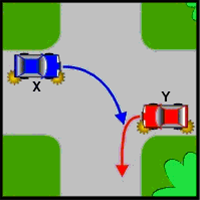
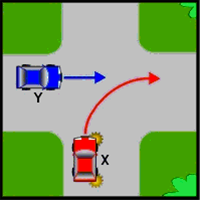
Q0168Quiz 6Give Way · Intersections
Which vehicle must give way?
AVehicle Y.
BNeither vehicle has to give way.
CVehicle X.
View answer and explanation
Answer: C
The text you provided is already in English. Here's a natural, concise version for the app:
Vehicle X is turning right and must give way to Vehicle Y, which is coming from the opposite direction and turning left into the same road.
📖 Reference: 3.13 — Intersections (give way). Give way to all traffic coming from the left or right, including turning vehicles. A vehicle entering a road from a driveway or terminating road must give way to traffic on the continuing road.
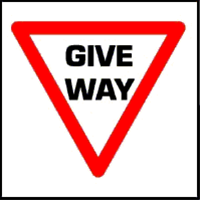
Q0169Quiz 6Markings · Signs
What is the meaning of this sign?
AGive way to traffic on the right only.
BStop and give way to all traffic.
CSlow down and give way to all traffic travelling along or turning from the intersecting road.
View answer and explanation
Answer: C
The text you provided is already in English, so there’s nothing to translate. If you meant to paste the Chinese original, please send it and I’ll convert it into natural, learner-friendly English.
📖 Reference: 3.8 — Traffic Signs. Signs are installed along our roads to make them safer for all users. Regulatory signs control traffic and must be obeyed; warning signs (diamond-shaped) alert you to hazards ahead.
Q0170Quiz 6Speed · Distances
Which of the following statements is correct?
AIt is always safe to travel at the speed limit.
BYour travelling speed should be as close to the speed limit as possible.
CTravelling at the speed limit is sometimes too fast for the conditions.
View answer and explanation
Answer: C
Sometimes the speed limit is too fast for the current conditions.
📖 Reference: 3.13 — Intersections (give way). Give way to all traffic coming from the left or right, including turning vehicles. A vehicle entering a road from a driveway or terminating road must give way to traffic on the continuing road.
Q0171Quiz 6Give Way · Intersections
Which vehicle must give way?
AVehicle Y.
BNeither vehicle has to give way.
CVehicle X.
View answer and explanation
Answer: A
At an intersection with no traffic signs or lights, you must give way to vehicles coming from your right. Since Vehicle X is approaching from Vehicle Y's right, Vehicle Y must give way.
📖 Reference: 3.13 — Intersections (give way). Give way to all traffic coming from the left or right, including turning vehicles. A vehicle entering a road from a driveway or terminating road must give way to traffic on the continuing road.
Q0172Quiz 6Mobile · Fatigue
Which of the following statements is correct?
AYou should not drive if you are tired.
BYour level of fatigue will be increased if you make stops on long trips.
CYou are more likely to become fatigued on short curving roads.
View answer and explanation
Answer: A
You should not drive when fatigued.
📖 Reference: 3.13 — Intersections (give way). Give way to all traffic coming from the left or right, including turning vehicles. A vehicle entering a road from a driveway or terminating road must give way to traffic on the continuing road.
Q0173Quiz 6Seatbelts · Vehicle
Which of the following statements is correct?
AYour stopping distance is not affected by the condition of your brakes and tyres.
BYour stopping distance is not affected by a loose road surface.
CYour stopping distance will increase if the road is wet.
View answer and explanation
Answer: C
When the road surface is wet and slippery, your stopping distance increases.
📖 Reference: 3.13 — Intersections (give way). Give way to all traffic coming from the left or right, including turning vehicles. A vehicle entering a road from a driveway or terminating road must give way to traffic on the continuing road.
Q0174Quiz 6Lights · Weather
How should you apply your brakes when driving in wet weather?
AHeavily, to dry the brakes out.
BCarefully, to avoid skidding.
CSharply, so that you can grip the road.
View answer and explanation
Answer: B
Brake gently in the rain to avoid skidding.
📖 Reference: 3.3.2 — Driving in wet or hazardous weather. When the road is wet, braking distance increases; braking hard on a wet road may cause your car to skid. To improve safety in wet weather, use your headlights and watch out for pedestrians, cyclists and other hazards.
Q0175Quiz 6Lights · Weather
If you are dazzled by another vehicle's headlights, what should you do?
APut your lights on highbeam.
BKeep left and look over the top of the approaching vehicle.
CSlow down, look left and if you cannot see, pull over and stop.
View answer and explanation
Answer: C
If you’re dazzled by oncoming lights: slow down, look left, and pull over if necessary.
📖 Reference: 3.3.1 / 3.3.3 — Driving at night / in fog. Drive with your headlights on between sunset and sunrise. You are legally required to dip your headlights within 200 metres of an approaching vehicle or when driving less than 200 metres behind another vehicle. In fog or smoke, dip your headlights and drive slowly.
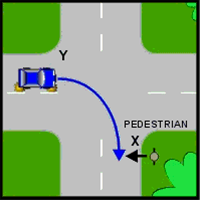
Q0176Quiz 6Pedestrians · Buses
Who must give way?
AThe pedestrian X.
BVehicle Y.
CNeither has to give way.
View answer and explanation
Answer: B
📖 Reference: 3.13 — Intersections (give way). Give way to all traffic coming from the left or right, including turning vehicles. A vehicle entering a road from a driveway or terminating road must give way to traffic on the continuing road.
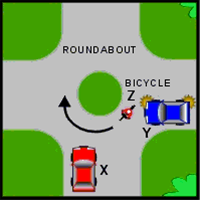
Q0177Quiz 6Give Way · Intersections
In which order should the vehicles proceed?
AVehicle X, then Y, then Z.
BVehicle Z, then Y, then X.
CVehicle X, then Z, then Y.
View answer and explanation
Answer: B
In Western Australia, traffic in roundabouts moves clockwise, so you must give way to vehicles approaching from your right. Since vehicles Z and Y are to the right of X, X must wait. And since Z (the bicycle) is ahead of Y, Z proceeds first.
📖 Reference: 3.13 — Intersections (give way). Give way to all traffic coming from the left or right, including turning vehicles. A vehicle entering a road from a driveway or terminating road must give way to traffic on the continuing road.
Q0178Quiz 6Turning · U-turns
Which is the correct path for the vehicle to take when turning into a two lane road?
AX is the correct path.
BY is the correct path.
CBoth paths are correct.
View answer and explanation
Answer: C
Official answer: Both paths are correct (both paths are acceptable).
📖 Reference: 3.14.2 — Turning. When turning right you must: indicate/signal before you turn; when lanes are not marked, move as close as possible to the left of the centre of the road and turn to the right of the centre of the intersection; give way to pedestrians.