27 questions · Based on public Transport WA quiz material and the Drive Safe handbook · English explanations and handbook references
Q0179Quiz 7Markings · Signs
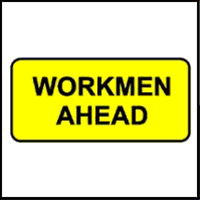
What should you do when you see this sign?
ASlow down and be prepared to stop.
BBe prepared to speed up to avoid workmen on the road.
CClose your windows to avoid damage from flying objects.
View answer and explanation
Answer: A
The "WORKMEN AHEAD" sign is a warning that road work is occurring further down the road, requiring drivers to reduce speed and exercise caution for the safety of workers.
📖 Reference: 3.8 — Traffic Signs. Signs are installed along our roads to make them safer for all users. Warning signs (diamond-shaped) alert you to hazards ahead and tell you what to do.
Q0180Quiz 7Give Way · Intersections
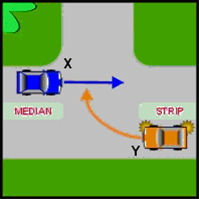
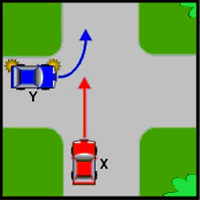
Which vehicle must give way?
AVehicle Y.
BVehicle X.
CNeither vehicle has to give way.
View answer and explanation
Answer: A
Vehicle Y is turning right across the path of Vehicle X, which is going straight, so Vehicle Y must give way.
📖 Reference: 3.13 — Intersections (give way). Give way to all traffic coming from the left or right, including turning vehicles. A vehicle entering a road from a driveway or terminating road must give way to traffic on the continuing road.
Q0181Quiz 7Pedestrians · Buses
If you are turning at an intersection where there are no traffic lights and pedestrians are crossing the road, what must you do?
AGive way to pedestrians only if you are turning right.
BGive way to pedestrians only if you are turning left.
CGive way to pedestrians at all times.
View answer and explanation
Answer: C
When turning at an intersection without traffic lights, always yield to pedestrians crossing the road.
📖 Reference: 3.10.1 — Intersection traffic control signals. Red means STOP. When the light is red, you must wait behind the stop line. A green arrow permits movement in the direction of the arrow; other lights still apply to other directions.
Q0182Quiz 7Overtaking · Lanes
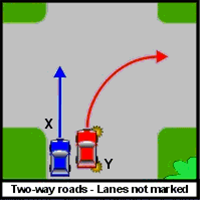
Which of the following statements is correct?
AVehicle X may overtake Y.
BVehicle X must not overtake Y.
CVehicle X may overtake Y, only in a 50km/h area.
View answer and explanation
Answer: A
On a two-way road with no marked lanes, a vehicle going straight (X) is allowed to overtake a vehicle turning right (Y) on the left side.
📖 Reference: 3.13 — Intersections (give way). Give way to all traffic coming from the left or right, including turning vehicles. A vehicle entering a road from a driveway or terminating road must give way to traffic on the continuing road.
Q0183Quiz 7Give Way · Intersections
Which of the following statements is correct?
AAlcohol has no effect on your driving ability.
BAlcohol makes you react faster to hazards.
CAlcohol makes you react more slowly to hazards.
View answer and explanation
Answer: C
Alcohol slows your reaction time.
📖 Reference: 3.13 — Intersections (give way). Give way to all traffic coming from the left or right, including turning vehicles. A vehicle entering a road from a driveway or terminating road must give way to traffic on the continuing road.
Q0184Quiz 7Give Way · Intersections
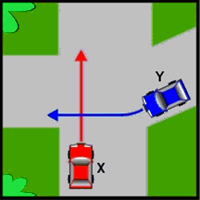
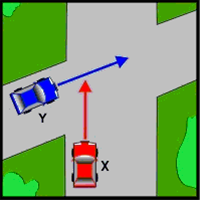
Which vehicle must give way?
AVehicle Y.
BNeither vehicle has to give way.
CVehicle X.
View answer and explanation
Answer: C
At an intersection with no signs or signals, Vehicle X must give way to any vehicle on its right, and Vehicle Y is approaching from X's right.
📖 Reference: 3.13 — Intersections (give way). Give way to all traffic coming from the left or right, including turning vehicles. A vehicle entering a road from a driveway or terminating road must give way to traffic on the continuing road.
Q0185Quiz 7Emergencies · First Aid
Is it an offence not to give way to an emergency vehicle?
AYes, if it is using a siren or flashing lights.
BYes.
CNo.
View answer and explanation
Answer: A
Failure to yield to emergency vehicles using sirens or flashing lights is illegal.
📖 Reference: 3.1.3 — Passing incident response vehicles. It is an offence not to give way to an emergency vehicle. Slow down and, if safe to do so, move over when passing stationary incident response vehicles displaying flashing lights (Slow Down, Move Over – SLOMO).
Q0186Quiz 7Traffic Lights
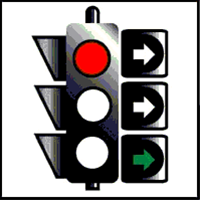
When approaching traffic lights, what does a red light with a green arrow (as shown in the diagram) mean?
AStop, until all lights show green.
BYou may proceed in the direction of the arrow.
CProceed in any direction.
View answer and explanation
Answer: B
The text you provided is already in English. If you meant to paste the Chinese original, please share it. Meanwhile, here’s a natural, concise version for the app:
"A green arrow means you can go in that direction even if the main traffic light is red."
📖 Reference: 3.10.1 — Intersection traffic control signals. Red means STOP. When the light is red, you must wait behind the stop line. A green arrow permits movement in the direction of the arrow; other lights still apply to other directions.
Q0187Quiz 7Lights · Weather
When should you switch your headlights on?
A20 minutes after sunset.
B15 minutes after sunset.
CAt sunset.
View answer and explanation
Answer: C
Turn on your lights at sunset.
📖 Reference: 3.3.1 / 3.3.3 — Driving at night / in fog. Drive with your headlights on between sunset and sunrise. You are legally required to dip your headlights within 200 metres of an approaching vehicle or when driving less than 200 metres behind another vehicle. In fog or smoke, dip your headlights and drive slowly.
Q0190Quiz 7Markings · Signs
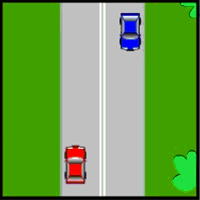
Is a vehicle allowed to cross over a double unbroken white line (as shown in the diagram)?
AYes, if the driver wishes to overtake another vehicle.
BNo.
CYes, if the driver wishes to make a right-hand turn or a 'U' turn and it is safe and legal to do so.
View answer and explanation
Answer: C
In Western Australia, you are generally prohibited from crossing double unbroken white lines, but you are permitted to cross them to make a right-hand turn into a side road or driveway, or to perform a U-turn, provided it is safe and legal.
📖 Reference: 3.9 — Road Markings. Broken white lines (dashed) separate lanes and may be crossed to overtake or turn right when it is safe to do so.
Q0191Quiz 7Give Way · Intersections
Which vehicle must give way?
ANeither vehicle has to give way.
BVehicle Y.
CVehicle X.
View answer and explanation
Answer: B
At an intersection with no traffic signs or signals, you must give way to vehicles approaching from your right. Vehicle X is approaching from the right of Vehicle Y.
📖 Reference: 3.13 — Intersections (give way). Give way to all traffic coming from the left or right, including turning vehicles. A vehicle entering a road from a driveway or terminating road must give way to traffic on the continuing road.
Q0192Quiz 7Alcohol · Drugs
What is the legal blood alcohol concentration (BAC) for novice drivers?
A0.00%.
B0.02%.
C0.05%.
View answer and explanation
Answer: A
For novice drivers, the BAC limit is 0.00%.
📖 Reference: 1.3.3 / 1.3.4 — Blood alcohol concentration (BAC). All novice drivers are subject to a zero blood alcohol limit (0.00%). The BAC limit for full licence drivers is 0.05%. Alcohol slows down your reaction time to road hazards and gives you a false sense of confidence.
Q0193Quiz 7Speed · Distances
Which of the following statements is correct?
AIt is always safe to travel at the speed limit.
BYour travelling speed should be as close to the speed limit as possible.
CTravelling at the speed limit is sometimes too fast for the conditions.
View answer and explanation
Answer: C
Speed limits are sometimes too fast for the current conditions.
📖 Reference: 3.13 — Intersections (give way). Give way to all traffic coming from the left or right, including turning vehicles. A vehicle entering a road from a driveway or terminating road must give way to traffic on the continuing road.
Q0194Quiz 7Give Way · Intersections
Which vehicle must give way?
AVehicle Y.
BVehicle X.
CNeither vehicle has to give way.
View answer and explanation
Answer: B
📖 Reference: 3.13 — Intersections (give way). Give way to all traffic coming from the left or right, including turning vehicles. A vehicle entering a road from a driveway or terminating road must give way to traffic on the continuing road.
Q0195Quiz 7Overtaking · Lanes
What area is known as a vehicle driver's blind spot?
AThe area beside the vehicle that the driver is not looking at.
BAn area behind or to the side of the vehicle that cannot be seen in the side or rear-view mirrors.
CAn area which can only be seen in the side or rear-view mirrors.
View answer and explanation
Answer: B
Blind spot = the area that rearview mirrors can’t see.
📖 Reference: 1.11 / 3.15 — Blind spots. There are blind spots at the sides and rear of your vehicle that cannot be seen in the mirrors. Check your blind spots by glancing over your shoulder before you move left or right.
Q0196Quiz 7Give Way · Intersections
Which vehicle must give way?
AVehicle Y.
BNeither vehicle has to give way.
CVehicle X.
View answer and explanation
Answer: A
At an intersection without traffic signs or lights, you must give way to vehicles approaching from your right, so Vehicle Y must give way to Vehicle X.
📖 Reference: 3.13 — Intersections (give way). Give way to all traffic coming from the left or right, including turning vehicles. A vehicle entering a road from a driveway or terminating road must give way to traffic on the continuing road.
Q0197Quiz 7Markings · Signs
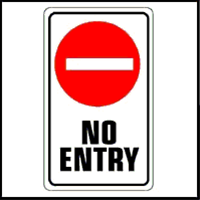
What is the meaning of this sign?
ANo entry for heavy vehicles.
BNo entry at any time.
CNo entry during daylight hours.
View answer and explanation
Answer: B
📖 Reference: 3.8 — Traffic Signs. Signs are installed along our roads to make them safer for all users. Regulatory signs control traffic and must be obeyed; warning signs (diamond-shaped) alert you to hazards ahead.
Q0198Quiz 7Alcohol · Drugs
What is the minimum penalty for a provisional driver with a BAC over 0.00%?
AA fine.
BA fine and accrual of demerit points.
CA fine and loss of licence.
View answer and explanation
Answer: B
Official answer: fine plus points. For a learner's permit, any BAC over 0.00% has a minimum penalty that includes points.
📖 Reference: 1.3.3 / 1.3.4 — Blood alcohol concentration (BAC). All novice drivers are subject to a zero blood alcohol limit (0.00%). The BAC limit for full licence drivers is 0.05%. Alcohol slows down your reaction time to road hazards and gives you a false sense of confidence.
Q0199Quiz 7Give Way · Intersections
When approaching a STOP sign that has no line marked on the road, where must you stop?
ANext to the STOP sign.
BAs close to the crossroad as possible without entering it.
CBefore the STOP sign.
View answer and explanation
Answer: B
STOP sign with no stop line: stop as close as possible to the intersection without entering it.
📖 Reference: 3.13.1 — Controlled intersections. At an intersection controlled by a ‘STOP’ sign, you must stop your vehicle and give way to all traffic travelling along or turning from the intersecting road. If there is no line, stop as close to the intersection as practicable but before entering it.
Q0200Quiz 7Speed · Distances
What is the speed limit in built-up areas where there are no speed limit signs?
A60km/h.
B50km/h.
C80km/h.
View answer and explanation
Answer: B
In built-up areas, the default speed limit is 50 km/h.
📖 Reference: 3.1.1 — Speed Limits. In a ‘built-up’ area, the default speed limit is 50 km/h unless a sign shows a different speed. Learner drivers: 100 km/h. Vehicles towing caravans or trailers: 100 km/h. Roadworks: obey the speed limit shown on the sign.
Q0201Quiz 7Give Way · Intersections
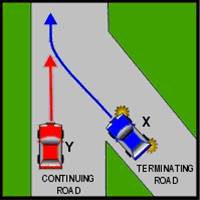
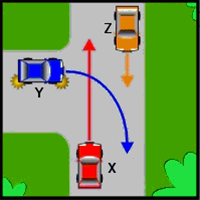
Which of the following statements is correct?
AVehicle X gives way to both Y and Z.
BVehicle Z gives way to both X and Y.
CVehicle Y gives way to both X and Z.
View answer and explanation
Answer: C
At a T-intersection, vehicle Y is on the road that ends, so it must give way to all vehicles (X and Z) on the road that continues through.
📖 Reference: 3.13 — Intersections (give way). Give way to all traffic coming from the left or right, including turning vehicles. A vehicle entering a road from a driveway or terminating road must give way to traffic on the continuing road.
Q0202Quiz 7Seatbelts · Vehicle
Which of the following statements is correct?
APassengers in vehicles are less likely to be injured in a crash if they are wearing seat belts.
BThe nature of injuries in motor vehicle crashes is not related to the wearing of seat belts.
CPassengers in rear seats of a vehicle are not required to wear seat belts.
View answer and explanation
Answer: A
Seat belts reduce the likelihood of injury.
📖 Reference: 3.13 — Intersections (give way). Give way to all traffic coming from the left or right, including turning vehicles. A vehicle entering a road from a driveway or terminating road must give way to traffic on the continuing road.
Q0203Quiz 7Overtaking · Lanes
Do you need to indicate if you overtake a vehicle on an unmarked two-way road?
AYes, only if there is a vehicle behind you.
BNo.
CYes.
View answer and explanation
Answer: C
On an unmarked two-way road, use your turn signal when overtaking.
📖 Reference: 3.16 — Overtaking. To overtake safely you must get a good view of the road ahead, check mirrors and blind spots, and only overtake when it is safe. You must not exceed the speed limit to overtake, and you must not overtake unless it can be done safely.
Q0204Quiz 7Overtaking · Lanes
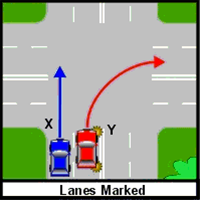
Which of the following statements is correct?
AVehicle X may overtake Y, only in a 60km/h area.
BVehicle X may overtake Y.
CVehicle X must not overtake Y.
View answer and explanation
Answer: B
Vehicle X is in a marked lane to the left of Vehicle Y. Since Vehicle Y is turning right, Vehicle X is allowed to pass (overtake) on the left.
📖 Reference: 3.13 — Intersections (give way). Give way to all traffic coming from the left or right, including turning vehicles. A vehicle entering a road from a driveway or terminating road must give way to traffic on the continuing road.
Q0205Quiz 7Lights · Weather
Is it legal for you to drive a motor vehicle at night with only one headlight working?
ANo.
BYes, if the right-hand headlight is visible.
CYes.
View answer and explanation
Answer: A
Driving at night with only one headlight is illegal.
📖 Reference: 3.3.1 / 3.3.3 — Driving at night / in fog. Drive with your headlights on between sunset and sunrise. You are legally required to dip your headlights within 200 metres of an approaching vehicle or when driving less than 200 metres behind another vehicle. In fog or smoke, dip your headlights and drive slowly.
Q0206Quiz 7Pedestrians · Buses
If you are turning at traffic lights and pedestrians are crossing the road, what must you do?
AGive way to pedestrians crossing the road.
BGo if you are turning with a green arrow.
CEase your way through the pedestrians.
View answer and explanation
Answer: A
When turning at a signalized intersection, yield to pedestrians who are crossing the road.
📖 Reference: 3.10.1 — Intersection traffic control signals. Red means STOP. When the light is red, you must wait behind the stop line. A green arrow permits movement in the direction of the arrow; other lights still apply to other directions.
Q0207Quiz 7Railway Crossings
At a railway crossing, are you allowed to cross if the train has passed, but the lights are still flashing?
AYes.
BNo.
CYes, unless the crossing has boom gates.
View answer and explanation
Answer: B
If the light is still flashing, you must not proceed.
📖 Reference: 3.5 — Railway Crossings. You must stop if warning bells or flashing red lights are operating, boom gates are down, or a train is coming. You may drive on only when it is safe and no train is approaching; if lights are still flashing you must not cross.