30 questions · Based on public Transport WA quiz material and the Drive Safe handbook · English explanations and handbook references
Q0001Quiz 1Markings · Signs
What does a broken white line down the centre of a road mean?
AYou must not cross the broken white line.
BYou may only cross the broken white line to turn right
CYou may cross the broken white line when overtaking or turning right, if it is safe to do so.
View answer and explanation
Answer: C
A dashed center line only prohibits "crossing at will": as long as it's safe, you may cross it when overtaking or turning right.
📖 Reference: 3.9 — Road Markings. Broken white lines (dashed) separate lanes and may be crossed to overtake or turn right when it is safe to do so.
Q0002Quiz 1Seatbelts · Vehicle
Are people over 65 years of age required to wear a seat belt?
ANo, if they are passengers.
BYes.
CNo, if they are driving.
View answer and explanation
Answer: B
Seat belts are mandatory for all ages, including people over 65.
📖 Reference: 1.4.4 — Who must wear a seat belt?. The driver and each passenger must be appropriately restrained and in a seated position. Seat belts must be worn by pregnant women. Children under 7 years must wear a suitable child restraint. You do not have to wear a seat belt when reversing.
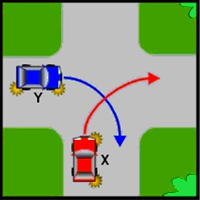
Q0003Quiz 1Give Way · Intersections
Which vehicle must give way?
AVehicle Y.
BVehicle X.
CNeither vehicle has to give way.
View answer and explanation
Answer: A
Vehicle Y is turning right across the path of Vehicle X, which is going straight ahead, so Vehicle Y must give way to the oncoming vehicle.
📖 Reference: 3.13 — Intersections (give way). Give way to all traffic coming from the left or right, including turning vehicles. A vehicle entering a road from a driveway or terminating road must give way to traffic on the continuing road.
Q0004Quiz 1Pedestrians · Buses
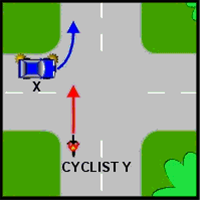
Who must give way?
ANeither has to give way.
BVehicle X.
CThe cyclist Y.
View answer and explanation
Answer: B
At an intersection with no lights or signs, a driver must give way to any vehicle on their right, and a cyclist is treated as a vehicle, so vehicle X must give way to cyclist Y approaching from its right.
📖 Reference: 3.13 — Intersections (give way). Give way to all traffic coming from the left or right, including turning vehicles. A vehicle entering a road from a driveway or terminating road must give way to traffic on the continuing road.
Q0005Quiz 1Give Way · Intersections
What is the basic rule that applies to uncontrolled four-way intersections?
AGive way to vehicles on your right.
BGive way to all vehicles.
CGive way to vehicles on your left.
View answer and explanation
Answer: A
At an intersection with no traffic lights, four-way junction: give way to vehicles approaching from your right ("give way to your right").
📖 Reference: 3.13.2 — Uncontrolled intersections. At an uncontrolled intersection, give way to vehicles approaching from your right. If you are turning right at any uncontrolled intersection YOU must also give way to oncoming traffic travelling towards you or turning left.
Q0006Quiz 1Seatbelts · Vehicle
Which of the following statements is correct?
ASudden braking can cause your vehicle to skid.
BBraking severely will always stop your vehicle the fastest.
CIf you have good tyres your vehicle will not skid.
View answer and explanation
Answer: A
Hard braking may cause the wheels to lock and skid; even good tires aren't guaranteed to prevent it.
📖 Reference: 3.13 — Intersections (give way). Give way to all traffic coming from the left or right, including turning vehicles. A vehicle entering a road from a driveway or terminating road must give way to traffic on the continuing road.
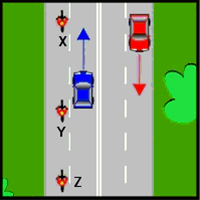
Q0007Quiz 1Overtaking · Lanes
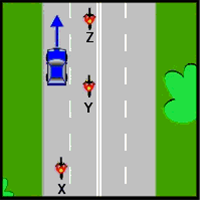
Which motorcycle is in the car driver's blind spot?
AMotorcycle Z.
BMotorcycle Y.
CMotorcycle X.
View answer and explanation
Answer: B
Motorcycle Y is in the adjacent lane, alongside the rear of the car — an area that can't be seen in the rear-view or side mirrors (the blind spot).
📖 Reference: 1.11 / 3.15 — Blind spots. There are blind spots at the sides and rear of your vehicle that cannot be seen in the mirrors. Check your blind spots by glancing over your shoulder before you move left or right.
Q0008Quiz 1Give Way · Intersections
When you want to cross an intersection, but you can see that the traffic ahead of you is banked up on the other side of the intersection, what must you do?
ASound your horn and move slowly forward.
BStop before entering and make sure that you will not block the intersection if you join the queue.
CJoin the queue of traffic.
View answer and explanation
Answer: B
When traffic is jammed at the intersection ahead, you must stop before entering it and not block the intersection (block the intersection).
📖 Reference: 3.13.4 — Keep intersections clear. Do not enter an intersection when a queue of traffic prevents you from fully exiting on the other side. Stop before you enter the intersection so that you do not block crossing traffic.
Q0009Quiz 1Railway Crossings
At a railway crossing, are you allowed to cross if the train has passed, but the lights are still flashing?
AYes.
BNo.
CYes, unless the crossing has boom gates.
View answer and explanation
Answer: B
Train has passed but the lights are still flashing = there may be another train coming, so do not cross.
📖 Reference: 3.5 — Railway Crossings. You must stop if warning bells or flashing red lights are operating, boom gates are down, or a train is coming. You may drive on only when it is safe and no train is approaching; if lights are still flashing you must not cross.
Q0010Quiz 1Traffic Lights
If you are travelling in a lane that has a left-turn arrow marked on the road, can you drive straight ahead?
AYes, if no other traffic is approaching.
BNo.
CYes.
View answer and explanation
Answer: B
If the lane is painted with a left-turn arrow, you can only turn left — going straight is not allowed.
📖 Reference: 3.10.2 — Intersection traffic control arrows. If you are turning, obey the arrow signal that is shown. A lane marked with a left-turn arrow requires you to turn left; you must not drive straight ahead.
Q0011Quiz 1Markings · Signs
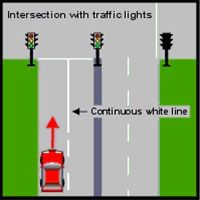
What does the continuous white line dividing the lanes mean?
AYou are allowed to change lanes if you are turning right.
BYou are not allowed to change lanes.
CYou are allowed to change lanes if you are turning left.
View answer and explanation
Answer: B
In Western Australia, you must not cross a continuous (solid) white line to change lanes.
📖 Reference: 3.9 — Road Markings. Where there is a single continuous (unbroken) dividing line (centre line), YOU must not cross that line except to leave or enter the road or turn at an intersection or ‘U’ turn.
Q0012Quiz 1Alcohol · Drugs
What is the minimum penalty for a novice driver with a BAC over 0.00%?
AA fine.
BA fine and accrual of demerit points.
CA fine and loss of licence.
View answer and explanation
Answer: B
Official answer: fine + points. For a novice driver, the minimum penalty for a BAC over 0.00% is a fine and points.
📖 Reference: 1.3.3 / 1.3.4 — Blood alcohol concentration (BAC). All novice drivers are subject to a zero blood alcohol limit (0.00%). The BAC limit for full licence drivers is 0.05%. Alcohol slows down your reaction time to road hazards and gives you a false sense of confidence.
Q0013Quiz 1Speed · Distances
What is the safest way to approach an intersection?
ATravelling at the speed limit for the area.
BTravelling at a speed that will allow you to stop if required.
CLooking steadily to the right.
View answer and explanation
Answer: B
The safest approach speed is the speed at which you can stop at any time — not the posted speed limit.
📖 Reference: 3.13 — Intersections. Approach intersections at a speed that will allow you to stop if required. Always be prepared to stop and look out for other vehicles and pedestrians.
Q0014Quiz 1Overtaking · Lanes
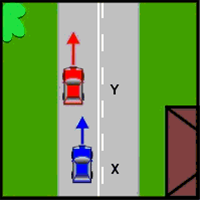
Is vehicle X allowed to overtake vehicle Y?
AYes, if it is safe to do so.
BNo.
CIt depends on the time of day
View answer and explanation
Answer: B
Official answer: No. In this diagram, X is not allowed to overtake Y.
📖 Reference: 3.16 — Overtaking. To overtake safely you must get a good view of the road ahead, check mirrors and blind spots, and only overtake when it is safe. You must not exceed the speed limit to overtake, and you must not overtake unless it can be done safely.
Q0015Quiz 1Alcohol · Drugs
Are passengers allowed to travel in the back of a utility or in an open load space?
AYes, if the vehicle does not exceed 60km/h.
BYes, providing they are seated.
CNo.
View answer and explanation
Answer: C
Pickup truck beds / open loading areas must not carry passengers.
📖 Reference: 1.4 / 5.4 — Regulations for your car. Passengers are not allowed to travel in the back of a utility or in an open load space. All occupants must be appropriately restrained.
Q0016Quiz 1Give Way · Intersections
Which of the following statements is correct?
AAlcohol has no effect on your driving ability.
BAlcohol makes you react faster to hazards.
CAlcohol makes you react more slowly to hazards.
View answer and explanation
Answer: C
Alcohol slows reaction time, not speeds it up.
📖 Reference: 3.13 — Intersections (give way). Give way to all traffic coming from the left or right, including turning vehicles. A vehicle entering a road from a driveway or terminating road must give way to traffic on the continuing road.
Q0017Quiz 1Stopping · Parking
Are you allowed to park a vehicle on a footpath?
ANo.
BYes, if it is a passenger vehicle.
CYes.
View answer and explanation
Answer: A
Parking on the sidewalk is prohibited.
📖 Reference: 3.17 — Stopping. You must not stop: within 10 metres of an intersection; within 20 metres of the approach side and 10 metres of the leaving side of a pedestrian/children’s crossing or bus stop; within one metre of a fire hydrant; within 20 metres of a railway crossing; within 3 metres of a letter box; or on a footpath.
Q0018Quiz 1Give Way · Intersections
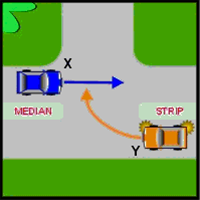
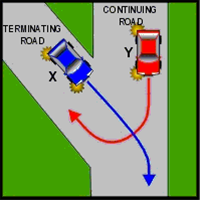
Which vehicle must give way?
AVehicle X.
BVehicle Y.
CNeither vehicle has to give way.
View answer and explanation
Answer: A
At a T-intersection, if you’re on the road that ends (Vehicle X), you must give way to all vehicles on the road that continues through (Vehicle Y).
📖 Reference: 3.13 — Intersections (give way). Give way to all traffic coming from the left or right, including turning vehicles. A vehicle entering a road from a driveway or terminating road must give way to traffic on the continuing road.
Q0019Quiz 1Give Way · Intersections
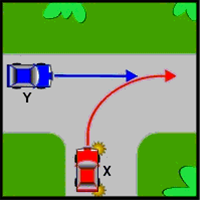
Which vehicle must give way?
ANeither vehicle has to give way.
BVehicle X.
CVehicle Y.
View answer and explanation
Answer: B
At a T-intersection, the vehicle on the terminating road (Vehicle X) must give way to all vehicles travelling on the continuing road (Vehicle Y).
📖 Reference: 3.13 — Intersections (give way). Give way to all traffic coming from the left or right, including turning vehicles. A vehicle entering a road from a driveway or terminating road must give way to traffic on the continuing road.
Q0020Quiz 1Speed · Distances
What is the speed limit in built-up areas where there are no speed limit signs?
A60km/h.
B50km/h.
C80km/h.
View answer and explanation
Answer: B
In built-up areas with no signs, the default speed limit is 50 km/h.
📖 Reference: 3.1.1 — Speed Limits. In a ‘built-up’ area, the default speed limit is 50 km/h unless a sign shows a different speed. Learner drivers: 100 km/h. Vehicles towing caravans or trailers: 100 km/h. Roadworks: obey the speed limit shown on the sign.
Q0021Quiz 1Give Way · Intersections
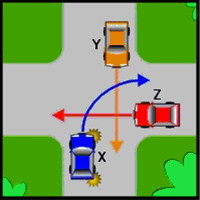
Which of the following statements is correct?
AVehicle X gives way to both Y and Z.
BVehicle Y gives way to both X and Z.
CVehicle Z gives way to both X and Y.
View answer and explanation
Answer: A
At an intersection without signs or lights, Vehicle X turning right must give way to the oncoming Vehicle Y going straight and to Vehicle Z approaching from the right.
📖 Reference: 3.13 — Intersections (give way). Give way to all traffic coming from the left or right, including turning vehicles. A vehicle entering a road from a driveway or terminating road must give way to traffic on the continuing road.
Q0022Quiz 1Give Way · Intersections
Which vehicle must give way?
AVehicle X.
BNeither vehicle has to give way.
CVehicle Y.
View answer and explanation
Answer: C
The text you provided is already in English. If you have the original Chinese, please share it. For
📖 Reference: 3.13 — Intersections (give way). Give way to all traffic coming from the left or right, including turning vehicles. A vehicle entering a road from a driveway or terminating road must give way to traffic on the continuing road.
Q0023Quiz 1Pedestrians · Buses
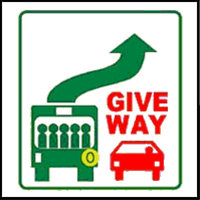
What is the meaning of this sign on the back of a bus?
AYou must give way to the bus if there is no other traffic on the road at the time.
BYou must give way to the bus if your speed is less than 70km/h.
CYou must give way to the bus if it is preparing to move out from a bus stop.
View answer and explanation
Answer: C
This sign indicates that drivers must give way to a bus that is signaling to enter the traffic flow from a bus stop.
📖 Reference: 1.3.3 / 1.3.4 — Blood alcohol concentration (BAC). All novice drivers are subject to a zero blood alcohol limit (0.00%). The BAC limit for full licence drivers is 0.05%. Alcohol slows down your reaction time to road hazards and gives you a false sense of confidence.
Q0024Quiz 1Emergencies · First Aid
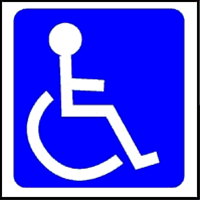
What is the meaning of this sign?
AParking is reserved for a person in a wheelchair.
BParking is reserved for emergency vehicles.
CParking is reserved for holders of a current ACROD parking permit.
View answer and explanation
Answer: C
This sign means the parking bay is reserved only for vehicles displaying a current ACROD (disability) parking permit.
📖 Reference: 3.8 — Traffic Signs. Signs are installed along our roads to make them safer for all users. Regulatory signs control traffic and must be obeyed; warning signs (diamond-shaped) alert you to hazards ahead.
Q0025Quiz 1Speed · Distances
Are you allowed to travel faster than the speed limit when you are overtaking a vehicle?
ANo.
BYes.
CYes, if the driver of the vehicle in front signals you to overtake
View answer and explanation
Answer: A
You must never exceed the speed limit when overtaking, no matter the circumstances.
📖 Reference: 3.16 — Overtaking. To overtake safely you must get a good view of the road ahead, check mirrors and blind spots, and only overtake when it is safe. You must not exceed the speed limit to overtake, and you must not overtake unless it can be done safely.
Q0026Quiz 1Overtaking · Lanes
What area is known as a vehicle driver's blind spot?
AThe area beside the vehicle that the driver is not looking at.
BAn area behind or to the side of the vehicle that cannot be seen in the side or rear-view mirrors.
CAn area which can only be seen in the side or rear-view mirrors.
View answer and explanation
Answer: B
Blind spot: the area beside or behind your car that cannot be seen in the rearview or side mirrors.
📖 Reference: 1.11 / 3.15 — Blind spots. There are blind spots at the sides and rear of your vehicle that cannot be seen in the mirrors. Check your blind spots by glancing over your shoulder before you move left or right.
Q0027Quiz 1Overtaking · Lanes
Which motorcycle is in the car driver's blind spot?
AMotorcycle X.
BMotorcycle Y.
CMotorcycle Z.
View answer and explanation
Answer: B
Motorcycle Y is alongside the rear left side of the car, in an area that can't be seen in the rear-view or side mirrors.
📖 Reference: 1.11 / 3.15 — Blind spots. There are blind spots at the sides and rear of your vehicle that cannot be seen in the mirrors. Check your blind spots by glancing over your shoulder before you move left or right.
Q0028Quiz 1Alcohol · Drugs
Is it an offence to refuse a breath test for alcohol?
ANo, providing you have a doctor's certificate.
BYes.
CNo.
View answer and explanation
Answer: B
Refusing to take a breath alcohol test is against the law.
📖 Reference: 1.3.3 / 1.3.4 — Blood alcohol concentration (BAC). All novice drivers are subject to a zero blood alcohol limit (0.00%). The BAC limit for full licence drivers is 0.05%. Alcohol slows down your reaction time to road hazards and gives you a false sense of confidence.
Q0029Quiz 1Lights · Weather
If you are dazzled by another vehicle's headlights, what should you do?
APut your lights on high beam.
BKeep left and look over the top of the approaching vehicle.
CSlow down, look left and if you cannot see, pull over and stop.
View answer and explanation
Answer: C
When dazzled by oncoming headlights: slow down, look to the left, and if you can’t see clearly, pull over and stop.
📖 Reference: 3.3.1 / 3.3.3 — Driving at night / in fog. Drive with your headlights on between sunset and sunrise. You are legally required to dip your headlights within 200 metres of an approaching vehicle or when driving less than 200 metres behind another vehicle. In fog or smoke, dip your headlights and drive slowly.
Q0030Quiz 1Lights · Weather
When should you dip your headlights?
AWhen you are within 50 metres of a vehicle.
BWhen you are within 200 metres of a vehicle.
CWhen you are dazzled by the lights of an on-coming vehicle.
View answer and explanation
Answer: B
Regulation: Within 200 meters of an oncoming vehicle, you must switch to low beams (dip).
📖 Reference: 3.3.1 / 3.3.3 — Driving at night / in fog. Drive with your headlights on between sunset and sunrise. You are legally required to dip your headlights within 200 metres of an approaching vehicle or when driving less than 200 metres behind another vehicle. In fog or smoke, dip your headlights and drive slowly.