29 questions · Based on public Transport WA quiz material and the Drive Safe handbook · English explanations and handbook references
Q0296Quiz 11Speed · Distances
What is the speed limit in built-up areas where there are no speed limit signs?
A60km/h.
B50km/h.
C80km/h.
View answer and explanation
Answer: B
Built-up areas default to 50 km/h.
📖 Reference: 3.1.1 — Speed Limits. In a ‘built-up’ area, the default speed limit is 50 km/h unless a sign shows a different speed. Learner drivers: 100 km/h. Vehicles towing caravans or trailers: 100 km/h. Roadworks: obey the speed limit shown on the sign.
Q0297Quiz 11Speed · Distances
What should you do when a driver is indicating to overtake you?
ASpeed up if you are travelling under the speed limit.
BMove as far to the left as possible and do not increase your speed.
CSignal the driver to remain behind you if you think he or she is travelling too fast.
View answer and explanation
Answer: B
When being overtaken, keep left and do not accelerate.
📖 Reference: 3.16 — Overtaking. To overtake safely you must get a good view of the road ahead, check mirrors and blind spots, and only overtake when it is safe. You must not exceed the speed limit to overtake, and you must not overtake unless it can be done safely.
Q0298Quiz 11Give Way · Intersections
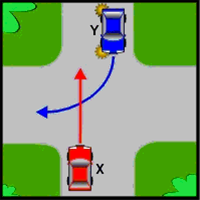
Which vehicle must give way?
ANeither vehicle has to give way.
BVehicle X.
CVehicle Y.
View answer and explanation
Answer: C
The provided text is already in English. Here’s a more natural, concise version for the app:
Vehicle Y is turning right across the path of Vehicle X, which is going straight. So Vehicle Y must give way to the oncoming vehicle.
📖 Reference: 3.13 — Intersections (give way). Give way to all traffic coming from the left or right, including turning vehicles. A vehicle entering a road from a driveway or terminating road must give way to traffic on the continuing road.
Q0299Quiz 11Give Way · Intersections
When approaching a STOP sign that has no line marked on the road, where must you stop?
ANext to the STOP sign.
BAs close to the crossroad as possible without entering it.
CBefore the STOP sign.
View answer and explanation
Answer: B
STOP no stop line: stop as close as possible to the intersection without entering it.
📖 Reference: 3.13.1 — Controlled intersections. At an intersection controlled by a ‘STOP’ sign, you must stop your vehicle and give way to all traffic travelling along or turning from the intersecting road. If there is no line, stop as close to the intersection as practicable but before entering it.
Q0300Quiz 11Traffic Lights
Does a police officer directing traffic over-rule traffic signs and traffic lights?
ANo.
BYes, if it is daylight.
CYes.
View answer and explanation
Answer: C
Police directions take priority over traffic signals.
📖 Reference: 3.13.1 — Controlled intersections. When a Police Officer or an authorised person is directing traffic, take your directions from that person. Their directions overrule traffic control signals and signs.
Q0301Quiz 11Seatbelts · Vehicle
Are people over 65 years of age required to wear a seat belt?
ANo, if they are passengers.
BYes.
CNo, if they are driving.
View answer and explanation
Answer: B
Those aged 65 and over must also wear seat belts.
📖 Reference: 1.4.4 — Who must wear a seat belt?. The driver and each passenger must be appropriately restrained and in a seated position. Seat belts must be worn by pregnant women. Children under 7 years must wear a suitable child restraint. You do not have to wear a seat belt when reversing.
Q0303Quiz 11Pedestrians · Buses
What is the minimum distance a vehicle is allowed to park after a bus stop or pedestrian crossing?
A3 metres.
B6 metres.
C10 metres.
View answer and explanation
Answer: C
Parking is prohibited within 10 meters of the departure side of a bus stop or pedestrian crossing (Handbook 3.17).
📖 Reference: 3.6 — Buses and Taxis. You must give way to a bus moving out from a bus stop in a ‘built-up’ area providing the bus is indicating and has a ‘GIVE WAY’ sign displayed on the back.
Q0304Quiz 11Overtaking · Lanes
What is the correct procedure when changing lanes?
ACheck your blind spot using the external mirrors, indicate and give way to traffic in the other lane.
BTouch your brake pedal to warn any drivers behind you, indicate and give way to traffic in the other lanes.
CCheck your mirrors, indicate to change lane for a sufficient distance to warn other drivers of your intention, look over your shoulder to check your blind spot, and give way to traffic in the other lane.
View answer and explanation
Answer: C
Lane change procedure: check mirrors → signal early → turn your head to check the blind spot → yield.
📖 Reference: 3.15 — Changing Lanes. To change lanes safely you should: check your internal and external mirrors; indicate/signal for a sufficient distance to warn other drivers; look over your shoulder to check your blind spot; and give way to traffic in the other lane.
Q0305Quiz 11Turning · U-turns
On a two-way road with no lanes marked, what position must your vehicle be before making a right-hand turn?
AOver the centre of the road.
BAs close to the left-hand side of the road as possible.
CTo the left of, the centre of the road.
View answer and explanation
Answer: C
Manual 3.14.2: Before turning right on an unmarked road, position yourself on the left side of the centre line (as close as possible to the left of the centre), and do not cross the centre.
📖 Reference: 3.14.2 / 3.4 — Turning / Keeping to the Left. When turning left you must move close to the left side of the road. When lanes are not marked, before turning right move as close as possible to the left of the centre of the road. If not preparing to turn, keep as far to the left of the road as practicable.
Q0306Quiz 11Pedestrians · Buses
What should you do to improve safety when travelling in heavy rain?
AUse your headlights and watch out for pedestrains, cyclists and other hazards.
BTurn on your radio to block out the sound of the rain.
CDrive the same as you would in dry weather conditions.
View answer and explanation
Answer: A
In heavy rain, turn on your lights and watch out for pedestrians and cyclists.
📖 Reference: 3.3.2 — Driving in wet or hazardous weather. When the road is wet, braking distance increases; braking hard on a wet road may cause your car to skid. To improve safety in wet weather, use your headlights and watch out for pedestrians, cyclists and other hazards.
Q0307Quiz 11Give Way · Intersections
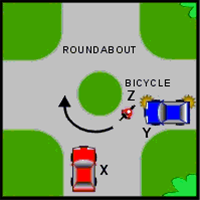
In which order should the vehicles proceed?
AVehicle X, then Y, then Z.
BVehicle Z, then Y, then X.
CVehicle X, then Z, then Y.
View answer and explanation
Answer: B
At a roundabout, you must give way to vehicles approaching from your right, so vehicle X must wait for both Z and Y. Vehicle Z goes before Y because it is farther ahead in the lane.
📖 Reference: 3.13 — Intersections (give way). Give way to all traffic coming from the left or right, including turning vehicles. A vehicle entering a road from a driveway or terminating road must give way to traffic on the continuing road.
Q0308Quiz 11Alcohol · Drugs
Is it an offence to refuse a breath test for alcohol?
ANo, providing you have a doctor's certificate.
BYes.
CNo.
View answer and explanation
Answer: B
Refusing a breath test is illegal.
📖 Reference: 1.3.3 / 1.3.4 — Blood alcohol concentration (BAC). All novice drivers are subject to a zero blood alcohol limit (0.00%). The BAC limit for full licence drivers is 0.05%. Alcohol slows down your reaction time to road hazards and gives you a false sense of confidence.
Q0309Quiz 11Pedestrians · Buses
If you are turning at traffic lights and pedestrians are crossing the road, what must you do?
AGive way to pedestrians crossing the road.
BGo if you are turning with a green arrow.
CEase your way through the pedestrians.
View answer and explanation
Answer: A
When turning at a signalized intersection, yield to pedestrians crossing the road.
📖 Reference: 3.10.1 — Intersection traffic control signals. Red means STOP. When the light is red, you must wait behind the stop line. A green arrow permits movement in the direction of the arrow; other lights still apply to other directions.
Q0310Quiz 11Give Way · Intersections
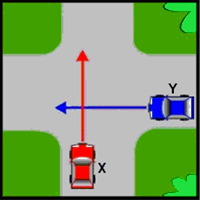
Which vehicle must give way?
ANeither vehicle has to give way.
BVehicle X.
CVehicle Y.
View answer and explanation
Answer: B
At an intersection with no traffic lights or signs, you must give way to vehicles coming from your right. Since Vehicle Y is on Vehicle X's right, Vehicle X must yield to Vehicle Y.
📖 Reference: 3.13 — Intersections (give way). Give way to all traffic coming from the left or right, including turning vehicles. A vehicle entering a road from a driveway or terminating road must give way to traffic on the continuing road.
Q0311Quiz 11Seatbelts · Vehicle
Which of the following statements is correct?
APassengers in vehicles are less likely to be injured in a crash if they are wearing seat belts.
BThe nature of injuries in motor vehicle crashes is not related to the wearing of seat belts.
CPassengers in rear seats of a vehicle are not required to wear seat belts.
View answer and explanation
Answer: A
Seat belts reduce the probability of injury.
📖 Reference: 3.13 — Intersections (give way). Give way to all traffic coming from the left or right, including turning vehicles. A vehicle entering a road from a driveway or terminating road must give way to traffic on the continuing road.
Q0312Quiz 11Lights · Weather
How should you apply your brakes when driving in wet weather?
AHeavily, to dry the brakes out.
BCarefully, to avoid skidding.
CSharply, so that you can grip the road.
View answer and explanation
Answer: B
In rainy conditions, brake gently to avoid skidding.
📖 Reference: 3.3.2 — Driving in wet or hazardous weather. When the road is wet, braking distance increases; braking hard on a wet road may cause your car to skid. To improve safety in wet weather, use your headlights and watch out for pedestrians, cyclists and other hazards.
Q0313Quiz 11Give Way · Intersections
Which of the following statements is correct?
AAlcohol has no effect on your driving ability.
BAlcohol makes you react faster to hazards.
CAlcohol makes you react more slowly to hazards.
View answer and explanation
Answer: C
Alcohol slows reaction time.
📖 Reference: 3.13 — Intersections (give way). Give way to all traffic coming from the left or right, including turning vehicles. A vehicle entering a road from a driveway or terminating road must give way to traffic on the continuing road.
Q0314Quiz 11Overtaking · Lanes
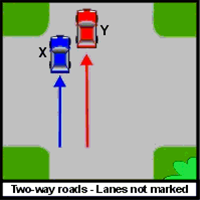
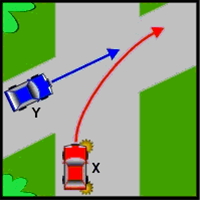
Which of the following statements is correct?
AVehicle X may overtake Y.
BVehicle X must not overtake Y.
CVehicle X may overtake Y, only in a 60km/h area
View answer and explanation
Answer: B
On a two-way road with no marked lanes, you must not overtake a vehicle on the left (unless it is turning right). The diagram shows Vehicle X positioned to pass on the left side.
📖 Reference: 3.13 — Intersections (give way). Give way to all traffic coming from the left or right, including turning vehicles. A vehicle entering a road from a driveway or terminating road must give way to traffic on the continuing road.
Q0315Quiz 11Overtaking · Lanes
For how long must you indicate before you overtake a vehicle?
ALong enough to give other road users sufficient warning of your intention.
BAt least 10 metres.
CAt least 100 metres.
View answer and explanation
Answer: A
Signal for long enough before overtaking.
📖 Reference: 3.16 — Overtaking. To overtake safely you must get a good view of the road ahead, check mirrors and blind spots, and only overtake when it is safe. You must not exceed the speed limit to overtake, and you must not overtake unless it can be done safely.
Q0316Quiz 11Speed · Distances
What is the maximum speed learner drivers (L-plates) are allowed to travel?
A110km/h.
B90km/h.
C100km/h.
View answer and explanation
Answer: C
L-plate learners are limited to 100 km/h.
📖 Reference: 3.1.1 — Speed Limits. In a ‘built-up’ area, the default speed limit is 50 km/h unless a sign shows a different speed. Learner drivers: 100 km/h. Vehicles towing caravans or trailers: 100 km/h. Roadworks: obey the speed limit shown on the sign.
Q0317Quiz 11Railway Crossings
At a railway crossing, are you allowed to cross if the train has passed, but the lights are still flashing?
AYes
BNo.
CYes, unless the crossing has boom gates.
View answer and explanation
Answer: B
The light is still flashing, so crossing is prohibited.
📖 Reference: 3.5 — Railway Crossings. You must stop if warning bells or flashing red lights are operating, boom gates are down, or a train is coming. You may drive on only when it is safe and no train is approaching; if lights are still flashing you must not cross.
Q0318Quiz 11Pedestrians · Buses
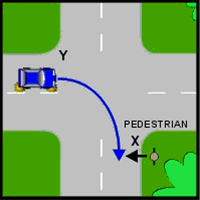
Who must give way?
AThe pedestrian X.
BVehicle Y.
CNeither has to give way.
View answer and explanation
Answer: B
When turning at an intersection, drivers must yield to pedestrians crossing the road they are turning into.
📖 Reference: 3.13 — Intersections (give way). Give way to all traffic coming from the left or right, including turning vehicles. A vehicle entering a road from a driveway or terminating road must give way to traffic on the continuing road.
Q0319Quiz 11Give Way · Intersections
Which vehicle must give way?
ANeither vehicle has to give way.
BVehicle Y.
CVehicle X.
View answer and explanation
Answer: B
Official answer: Vehicle Y yields (confirmed by official scoring).
📖 Reference: 3.13 — Intersections (give way). Give way to all traffic coming from the left or right, including turning vehicles. A vehicle entering a road from a driveway or terminating road must give way to traffic on the continuing road.
Q0320Quiz 11Traffic Lights
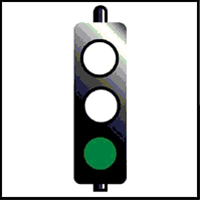
If you are turning right at traffic lights and the light is green (as shown in the diagram), what should you do?
ATurn only if you can do so without interfering with other traffic.
BWait until the light changes to red and then turn quickly.
CDo not move until the light changes to yellow and then turn quickly.
View answer and explanation
Answer: A
When turning right on a solid green light, you must give way to oncoming traffic and pedestrians, and only proceed with the turn when it is safe to do so.
📖 Reference: 3.10.1 / 3.13.1 — Traffic control signals / Intersections. When turning right at a green light you must give way to oncoming traffic and pedestrians. Green means proceed only if the way is clear.
Q0321Quiz 11Markings · Signs
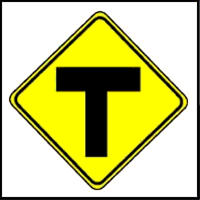
What is the meaning of this sign?
ACaution, you are approaching a one-way street.
BCaution, you are approaching a 'T' junction.
CCaution, no through road.
View answer and explanation
Answer: B
📖 Reference: 3.8 — Traffic Signs. Signs are installed along our roads to make them safer for all users. Regulatory signs control traffic and must be obeyed; warning signs (diamond-shaped) alert you to hazards ahead.
Q0322Quiz 11Alcohol · Drugs
What is the legal blood alcohol concentration (BAC) for drivers with a full licence?
ALess than 0.02%
BLess than 0.05%.
CLess than 0.08%.
View answer and explanation
Answer: B
For a full driver’s licence, the legal limit is BAC < 0.05%.
📖 Reference: 1.3.3 / 1.3.4 — Blood alcohol concentration (BAC). All novice drivers are subject to a zero blood alcohol limit (0.00%). The BAC limit for full licence drivers is 0.05%. Alcohol slows down your reaction time to road hazards and gives you a false sense of confidence.
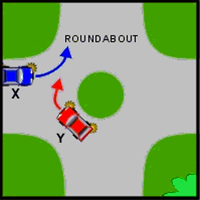
Q0323Quiz 11Give Way · Intersections
Which vehicle must give way?
ANeither vehicle has to give way.
BVehicle Y.
CVehicle X.
View answer and explanation
Answer: C
When entering a roundabout, you must give way to all vehicles already in the roundabout and vehicles approaching from your right. Since Vehicle Y is approaching from Vehicle X's right, Vehicle X must give way.
📖 Reference: 3.13 — Intersections (give way). Give way to all traffic coming from the left or right, including turning vehicles. A vehicle entering a road from a driveway or terminating road must give way to traffic on the continuing road.
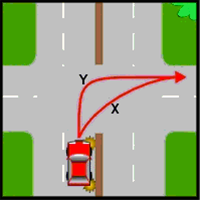
Q0324Quiz 11Turning · U-turns
Which is the correct path for the vehicle to take when turning right at an intersection?
AX is the correct path.
BY is the correct path.
CBoth paths are correct.
View answer and explanation
Answer: A
Official answer: X is the correct path (the correct path for a right turn).
📖 Reference: 3.14.2 — Turning. When turning right you must: indicate/signal before you turn; when lanes are not marked, move as close as possible to the left of the centre of the road and turn to the right of the centre of the intersection; give way to pedestrians.
Q0325Quiz 11Emergencies · First Aid
What should you do when there is an emergency vehicle in your immediate vicinity? (Select all that apply)
ADo not panic, check where the emergency vehicle is coming from and give way to it.
BMove as far as to the left of the road if you can.
CIf you cannot move left, slow down or stop. Let the emergency vehicle drive around you.
View answer and explanation
Answer: A,B,C
Official answer (multi-select: all three): do not panic, confirm where the emergency vehicle is coming from and yield; move left if you can; if you cannot move left, slow down or stop and let the emergency vehicle go around.
📖 Reference: 3.1.3 — Passing incident response vehicles. It is an offence not to give way to an emergency vehicle. Slow down and, if safe to do so, move over when passing stationary incident response vehicles displaying flashing lights (Slow Down, Move Over – SLOMO).