30 questions · Based on public Transport WA quiz material and the Drive Safe handbook · English explanations and handbook references
Q0061Quiz 3Pedestrians · Buses
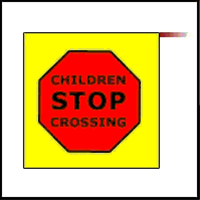
What must you do at a children's crossing when a crossing attendant extends this flag?
AStop and do not proceed until the attendant withdraws the sign.
BSlow down.
CDrive on carefully if no children are on your side of the crossing.
View answer and explanation
Answer: A
When a crossing attendant displays a "STOP" sign at a children's crossing, drivers are legally required to come to a complete stop and must not proceed until the sign is withdrawn.
📖 Reference: 1.8.1 — Pedestrians. Always keep a look out for pedestrians and be ready to stop for them. Give way to pedestrians crossing at intersections and at pedestrian/children’s crossings. At children’s crossings you must stop when the crossing attendant extends the flags.
Q0062Quiz 3Alcohol · Drugs
Can medication used for colds or travel sickness affect your driving?
ANo.
BYes.
CNo, unless it has been prescribed by a doctor.
View answer and explanation
Answer: B
Medications such as cold remedies and motion sickness pills can affect driving, even over-the-counter ones.
📖 Reference: 1.3.6 — Effect of alcohol and other drugs on driving. Medications for the common cold or travel sickness can seriously affect your driving ability. Check with your doctor or chemist about the effect they may have.
Q0063Quiz 3Speed · Distances
When are you allowed to sound your vehicle's horn?
AOnly when you are travelling outside built-up areas.
BOnly when it is used as a warning device.
CAt any time.
View answer and explanation
Answer: B
The horn should only be used as a warning device.
📖 Reference: 1.11 — Pre-Driving Checks (horn). Only use your horn to warn other road users of danger – it is an offence to use it for other purposes.
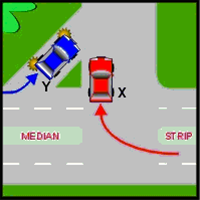
Q0064Quiz 3Give Way · Intersections
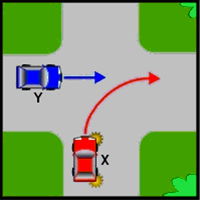
Which vehicle must give way?
AVehicle Y.
BNeither vehicle has to give way.
CVehicle X.
View answer and explanation
Answer: A
📖 Reference: 3.13 — Intersections (give way). Give way to all traffic coming from the left or right, including turning vehicles. A vehicle entering a road from a driveway or terminating road must give way to traffic on the continuing road.
Q0065Quiz 3Emergencies · First Aid
What should you do if your vehicle catches fire?
AAccelerate to blow out the flames.
BSound your horn to warn other drivers.
CStop and turn off the ignition.
View answer and explanation
Answer: C
If the vehicle catches fire: stop immediately and turn off the ignition.
📖 Reference: 4.2.10 — Car fire. If your vehicle catches fire: slow down and stop and turn off the ignition; get passengers out and away from the fire; call for help.
Q0066Quiz 3Traffic Lights
Does a police officer directing traffic over-rule traffic signs and traffic lights?
ANo.
BYes, if it is daylight.
CYes.
View answer and explanation
Answer: C
When police officers are directing traffic, their hand signals take priority over traffic lights and signs.
📖 Reference: 3.13.1 — Controlled intersections. When a Police Officer or an authorised person is directing traffic, take your directions from that person. Their directions overrule traffic control signals and signs.
Q0067Quiz 3Traffic Lights
When approaching traffic lights, what does a green light with a red arrow mean?
AYou may go in any direction other than that indicated by the arrow.
BYou may turn in the direction of the arrow, if it is safe to do so.
CStop, the lights are not working properly.
View answer and explanation
Answer: A
Green light with red arrow: You may proceed in any direction except the arrow’s direction; that direction is prohibited.
📖 Reference: 3.10.1 — Intersection traffic control signals. Red means STOP. When the light is red, you must wait behind the stop line. A green arrow permits movement in the direction of the arrow; other lights still apply to other directions.
Q0068Quiz 3Speed · Distances
What is the maximum speed vehicles towing a caravan or trailer are allowed to travel?
A110km/h.
B90km/h.
C100km/h.
View answer and explanation
Answer: C
Maximum speed limit for towed caravans/trailers: 100 km/h.
📖 Reference: 3.1.1 — Speed Limits. In a ‘built-up’ area, the default speed limit is 50 km/h unless a sign shows a different speed. Learner drivers: 100 km/h. Vehicles towing caravans or trailers: 100 km/h. Roadworks: obey the speed limit shown on the sign.
Q0069Quiz 3Overtaking · Lanes
What should you do if you are travelling slowly on a two-way road and there is a queue of vehicles behind you?
APull well over to the left and allow the vehicles to overtake you.
BKeep to the middle of the road to prevent dangerous overtaking.
CKeep well to the right so the queue of vehicles can overtake on the left.
View answer and explanation
Answer: A
When driving slowly and being overtaken by a queue of vehicles, keep left and give way.
📖 Reference: 3.4 — Keeping to the Left. If you are driving a slow moving vehicle, pull well over to the left to allow following traffic to overtake.
Q0070Quiz 3Give Way · Intersections
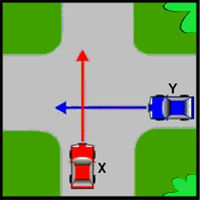
Which vehicle must give way?
ANeither vehicle has to give way.
BVehicle X.
CVehicle Y.
View answer and explanation
Answer: B
At an uncontrolled intersection (no signs or lights), you must give way to vehicles approaching from your right, and Vehicle Y is on the right of Vehicle X.
📖 Reference: 3.13 — Intersections (give way). Give way to all traffic coming from the left or right, including turning vehicles. A vehicle entering a road from a driveway or terminating road must give way to traffic on the continuing road.
Q0071Quiz 3Overtaking · Lanes
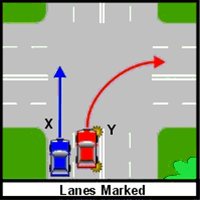
Which of the following statements is correct?
AVehicle X may overtake Y, only in a 60km/h area.
BVehicle X may overtake Y.
CVehicle X must not overtake Y.
View answer and explanation
Answer: B
Vehicle X may pass Vehicle Y on the left because Vehicle Y is turning right and signaling a right turn.
📖 Reference: 3.13 — Intersections (give way). Give way to all traffic coming from the left or right, including turning vehicles. A vehicle entering a road from a driveway or terminating road must give way to traffic on the continuing road.
Q0072Quiz 3Traffic Lights
What is the minimum distance a vehicle is allowed to park from an intersection controlled by traffic lights?
A3 metres.
B6 metres.
C20 metres.
View answer and explanation
Answer: C
Within 20 meters of a traffic light intersection, parking is prohibited.
📖 Reference: 3.17 — Stopping. You must not stop: within 10 metres of an intersection; within 20 metres of the approach side and 10 metres of the leaving side of a pedestrian/children’s crossing or bus stop; within one metre of a fire hydrant; within 20 metres of a railway crossing; within 3 metres of a letter box; or on a footpath.
Q0073Quiz 3Stopping · Parking
What must you do before pulling out from a parked position at a kerb?
ASound your horn.
BCheck your mirror, indicate to give other drivers sufficient warning of your intentions, check your blind spot prior to pulling out.
CAdjust your passenger-side external mirror.
View answer and explanation
Answer: B
Before pulling out from the roadside: check mirrors, signal, and turn your head to check the blind spot.
📖 Reference: 3.18.2 — How to park. Before pulling out from a parking spot: check for other traffic, indicate/signal for at least 5 seconds, and drive off smoothly into a safe gap in traffic.
Q0074Quiz 3Seatbelts · Vehicle
When is a driver allowed to drive without a seat belt?
AWhen reversing a vehicle.
BWhen aged 65 years and over.
CWhen the driver is pregnant.
View answer and explanation
Answer: A
When reversing, you may temporarily not wear your seatbelt (low speed, short distance).
📖 Reference: 1.4.4 — Who must wear a seat belt?. The driver and each passenger must be appropriately restrained and in a seated position. Seat belts must be worn by pregnant women. Children under 7 years must wear a suitable child restraint. You do not have to wear a seat belt when reversing.
Q0075Quiz 3Seatbelts · Vehicle
Which of the following statements is correct?
AAll passengers must wear available seat belts or suitable child restraints.
BOnly passengers over the age of 8 years must wear a seat belt.
CPassengers over the age of 65 do not have to wear seat belts.
View answer and explanation
Answer: A
All passengers must wear seat belts or use a child restraint.
📖 Reference: 3.13 — Intersections (give way). Give way to all traffic coming from the left or right, including turning vehicles. A vehicle entering a road from a driveway or terminating road must give way to traffic on the continuing road.
Q0076Quiz 3Give Way · Intersections
Which vehicle must give way?
AVehicle X.
BVehicle Y.
CNeither vehicle has to give way.
View answer and explanation
Answer: B
📖 Reference: 3.13 — Intersections (give way). Give way to all traffic coming from the left or right, including turning vehicles. A vehicle entering a road from a driveway or terminating road must give way to traffic on the continuing road.
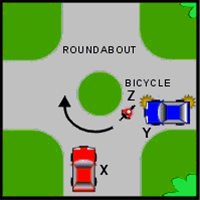
Q0077Quiz 3Give Way · Intersections
In which order should the vehicles proceed?
AVehicle X, then Y, then Z.
BVehicle Z, then Y, then X.
CVehicle X, then Z, then Y.
View answer and explanation
Answer: B
Vehicle Z is already in the roundabout (or ahead entering from the right), and Vehicle Y is approaching from the right of Vehicle X, so X must give way to both. This means the order is Z, then Y, then X.
📖 Reference: 3.13 — Intersections (give way). Give way to all traffic coming from the left or right, including turning vehicles. A vehicle entering a road from a driveway or terminating road must give way to traffic on the continuing road.
Q0078Quiz 3Mobile · Fatigue
Which of the following statements is correct?
AYou should not drive if you are tired.
BYour level of fatigue will be increased if you make stops on long trips.
CYou are more likely to become fatigued on short curving roads.
View answer and explanation
Answer: A
Do not drive when you're fatigued; taking breaks along the way can help relieve tiredness.
📖 Reference: 3.13 — Intersections (give way). Give way to all traffic coming from the left or right, including turning vehicles. A vehicle entering a road from a driveway or terminating road must give way to traffic on the continuing road.
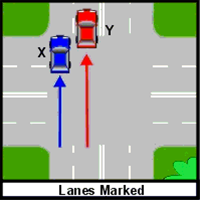
Q0079Quiz 3Overtaking · Lanes
Which of the following statements is correct?
AVehicle X may overtake Y.
BVehicle X must not overtake Y.
CVehicle X may overtake Y, only in a 60km/h area.
View answer and explanation
Answer: A
On a multi-lane road with marked lanes, you're allowed to overtake on the left if the vehicle you're passing is in a right-hand lane.
📖 Reference: 3.13 — Intersections (give way). Give way to all traffic coming from the left or right, including turning vehicles. A vehicle entering a road from a driveway or terminating road must give way to traffic on the continuing road.
Q0080Quiz 3Railway Crossings
What is the minimum distance a vehicle is allowed to park from a railway crossing?
A6 metres.
B20 metres.
C3 metres.
View answer and explanation
Answer: B
Parking is prohibited within 20 meters of a railway crossing.
📖 Reference: 3.5 — Railway Crossings. You must stop if warning bells or flashing red lights are operating, boom gates are down, or a train is coming. You may drive on only when it is safe and no train is approaching; if lights are still flashing you must not cross.
Q0081Quiz 3Pedestrians · Buses
What is the minimum distance a vehicle is allowed to park after a bus stop or pedestrian crossing?
A3 metres.
B6 metres.
C10 metres.
View answer and explanation
Answer: C
No parking within 10 meters after a bus stop or pedestrian crossing (leaving side), or within 20 meters before it (approach side) (Handbook 3.17).
📖 Reference: 3.6 — Buses and Taxis. You must give way to a bus moving out from a bus stop in a ‘built-up’ area providing the bus is indicating and has a ‘GIVE WAY’ sign displayed on the back.
Q0082Quiz 3Speed · Distances
What is the speed limit where roads are under construction or repair?
A20km/h.
BThe speed limit shown on the road works sign.
C40km/h.
View answer and explanation
Answer: B
In construction zones, the speed limit is determined by the construction signs.
📖 Reference: 3.1.1 — Speed Limits. In a ‘built-up’ area, the default speed limit is 50 km/h unless a sign shows a different speed. Learner drivers: 100 km/h. Vehicles towing caravans or trailers: 100 km/h. Roadworks: obey the speed limit shown on the sign.
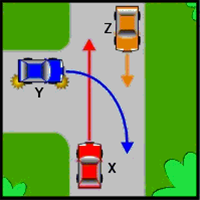
Q0083Quiz 3Give Way · Intersections
Which of the following statements is correct?
AVehicle X gives way to both Y and Z.
BVehicle Z gives way to both X and Y.
CVehicle Y gives way to both X and Z.
View answer and explanation
Answer: C
Vehicle Y is on the terminating road of a T-intersection and must give way to all vehicles (X and Z) on the continuing road.
📖 Reference: 3.13 — Intersections (give way). Give way to all traffic coming from the left or right, including turning vehicles. A vehicle entering a road from a driveway or terminating road must give way to traffic on the continuing road.
Q0084Quiz 3Overtaking · Lanes
What is the correct procedure when changing lanes?
ACheck your blind spot using the external mirrors, indicate and give way to traffic in the other lane.
BTouch your brake pedal to warn any drivers behind you, indicate and give way to traffic in the other lane.
CCheck your internal and external mirrors, indicate/signal to change lanes for a sufficient distance to warn other drivers of your intentions before beginning your manoeuvre and glance over your shoulder to check your blind spot.
View answer and explanation
Answer: C
Lane change procedure: check inside and exterior mirrors → signal early → turn your head to check the blind spot → yield.
📖 Reference: 3.15 — Changing Lanes. To change lanes safely you should: check your internal and external mirrors; indicate/signal for a sufficient distance to warn other drivers; look over your shoulder to check your blind spot; and give way to traffic in the other lane.
Q0085Quiz 3Traffic Lights
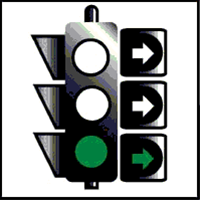
When approaching traffic lights, what does a green light with a green arrow (as shown in the diagram) mean?
AYou may turn right only.
BYou may turn right or drive straight ahead.
CYou may drive straight ahead only.
View answer and explanation
Answer: B
The green circular light allows you to drive straight ahead (or turn if safe), and the green arrow specifically permits a right turn, so you are allowed to do either.
📖 Reference: 3.10.1 — Intersection traffic control signals. Red means STOP. When the light is red, you must wait behind the stop line. A green arrow permits movement in the direction of the arrow; other lights still apply to other directions.
Q0086Quiz 3Lights · Weather
Is it legal for you to drive a motor vehicle at night with only one headlight working?
ANo.
BYes, if the right-hand headlight is visible.
CYes.
View answer and explanation
Answer: A
At night, you are not allowed to drive with only one headlight on.
📖 Reference: 3.3.1 / 3.3.3 — Driving at night / in fog. Drive with your headlights on between sunset and sunrise. You are legally required to dip your headlights within 200 metres of an approaching vehicle or when driving less than 200 metres behind another vehicle. In fog or smoke, dip your headlights and drive slowly.
Q0087Quiz 3Alcohol · Drugs
What is the legal blood alcohol concentration (BAC) for drivers with a full licence?
ALess than 0.02%.
BLess than 0.05%.
CLess than 0.08%
View answer and explanation
Answer: B
The legal BAC for a full driver's license is below 0.05%.
📖 Reference: 1.3.3 / 1.3.4 — Blood alcohol concentration (BAC). All novice drivers are subject to a zero blood alcohol limit (0.00%). The BAC limit for full licence drivers is 0.05%. Alcohol slows down your reaction time to road hazards and gives you a false sense of confidence.
Q0088Quiz 3Overtaking · Lanes
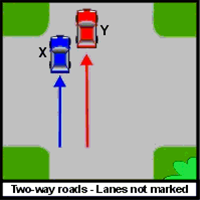
Which of the following statements is correct?
AVehicle X may overtake Y.
BVehicle X must not overtake Y.
CVehicle X may overtake Y, only in a 60km/h area.
View answer and explanation
Answer: B
On an unmarked two-way road, do not overtake on the left unless the vehicle ahead is turning right or is stopped. In the diagram, Vehicle X is shown passing Vehicle Y on the left.
📖 Reference: 3.13 — Intersections (give way). Give way to all traffic coming from the left or right, including turning vehicles. A vehicle entering a road from a driveway or terminating road must give way to traffic on the continuing road.
Q0089Quiz 3Pedestrians · Buses
What is the rule regarding overtaking at a pedestrian crossing?
AYou must not overtake a vehicle that has stopped at a pedestrian crossing.
BGive way to pedestrians on your right.
CGive way to pedestrians on your left.
View answer and explanation
Answer: A
Do not overtake vehicles that have stopped before a pedestrian crossing.
📖 Reference: 3.16 — Overtaking. To overtake safely you must get a good view of the road ahead, check mirrors and blind spots, and only overtake when it is safe. You must not exceed the speed limit to overtake, and you must not overtake unless it can be done safely.
Q0090Quiz 3Give Way · Intersections
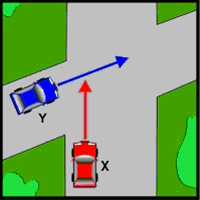
Which vehicle must give way?
AVehicle Y.
BNeither vehicle has to give way.
CVehicle X.
View answer and explanation
Answer: A
Official answer: Vehicle Y gives way (confirmed by official marking).
📖 Reference: 3.13 — Intersections (give way). Give way to all traffic coming from the left or right, including turning vehicles. A vehicle entering a road from a driveway or terminating road must give way to traffic on the continuing road.