28 questions · Based on public Transport WA quiz material and the Drive Safe handbook · English explanations and handbook references
Q0208Quiz 8Alcohol · Drugs
Are passengers allowed to travel in the back of a utility or in an open load space?
AYes, if the vehicle does not exceed 60km/h.
BYes, providing they are seated.
CNo.
View answer and explanation
Answer: C
Passengers are not allowed in the cargo bed of a pickup truck.
📖 Reference: 1.4 / 5.4 — Regulations for your car. Passengers are not allowed to travel in the back of a utility or in an open load space. All occupants must be appropriately restrained.
Q0209Quiz 8Give Way · Intersections
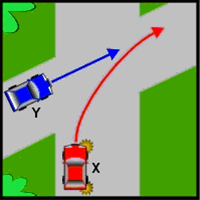
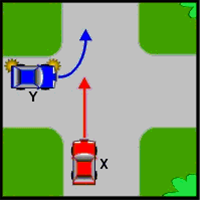
Which vehicle must give way?
ANeither vehicle has to give way.
BVehicle Y.
CVehicle X.
View answer and explanation
Answer: B
Official answer: Vehicle Y gives way (confirmed by official marking).
📖 Reference: 3.13 — Intersections (give way). Give way to all traffic coming from the left or right, including turning vehicles. A vehicle entering a road from a driveway or terminating road must give way to traffic on the continuing road.
Q0210Quiz 8Traffic Lights
If you are travelling in a lane that has a left-turn arrow marked on the road, can you drive straight ahead?
AYes, if no other traffic is approaching.
BNo.
CYes.
View answer and explanation
Answer: B
You cannot go straight from a lane marked with a left-turn arrow.
📖 Reference: 3.10.2 — Intersection traffic control arrows. If you are turning, obey the arrow signal that is shown. A lane marked with a left-turn arrow requires you to turn left; you must not drive straight ahead.
Q0211Quiz 8Markings · Signs
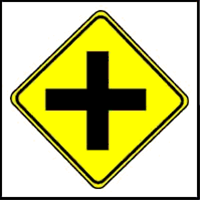
What is the meaning of this sign?
ANo entry.
BCaution, crossroad ahead.
CCaution, ambulance depot.
View answer and explanation
Answer: B
This yellow diamond-shaped sign with a black cross is a standard warning sign indicating that there is a crossroad intersection ahead.
📖 Reference: 3.8 — Traffic Signs. Signs are installed along our roads to make them safer for all users. Regulatory signs control traffic and must be obeyed; warning signs (diamond-shaped) alert you to hazards ahead.
Q0212Quiz 8Give Way · Intersections
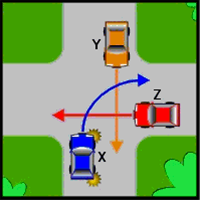
Which of the following statements is correct?
AVehicle X gives way to both Y and Z.
BVehicle Y gives way to both X and Z.
CVehicle Z gives way to both X and Y.
View answer and explanation
Answer: A
Vehicle X is turning right and must give way to Vehicle Y, which is going straight from the opposite direction, and Vehicle Z, which is approaching from the right and going straight.
📖 Reference: 3.13 — Intersections (give way). Give way to all traffic coming from the left or right, including turning vehicles. A vehicle entering a road from a driveway or terminating road must give way to traffic on the continuing road.
Q0213Quiz 8Speed · Distances
What is the speed limit where roads are under construction or repair?
A20km/h.
BThe speed limit shown on the road works sign.
C40km/h.
View answer and explanation
Answer: B
On construction sections, follow the speed limit shown on the signs.
📖 Reference: 3.1.1 — Speed Limits. In a ‘built-up’ area, the default speed limit is 50 km/h unless a sign shows a different speed. Learner drivers: 100 km/h. Vehicles towing caravans or trailers: 100 km/h. Roadworks: obey the speed limit shown on the sign.
Q0214Quiz 8Alcohol · Drugs
Is it an offence to refuse a breath test for alcohol?
ANo, providing you have a doctor's certificate.
BYes.
CNo.
View answer and explanation
Answer: B
Refusing a breath test is illegal.
📖 Reference: 1.3.3 / 1.3.4 — Blood alcohol concentration (BAC). All novice drivers are subject to a zero blood alcohol limit (0.00%). The BAC limit for full licence drivers is 0.05%. Alcohol slows down your reaction time to road hazards and gives you a false sense of confidence.
Q0215Quiz 8Overtaking · Lanes
What is the correct procedure when changing lanes?
ACheck your blind spot using the external mirrors, indicate and give way to traffic in the other lane.
BTouch your brake pedal to warn any drivers behind you, indicate and give way to traffic in the other lane.
CCheck your mirrors, indicate to change lane for a sufficient distance to warn other drivers of your intention, look over your shoulder to check your blind spot, and give way to traffic in the other lane.
View answer and explanation
Answer: C
Lane change procedure: check mirrors → signal early → turn your head to check the blind spot → yield.
📖 Reference: 3.15 — Changing Lanes. To change lanes safely you should: check your internal and external mirrors; indicate/signal for a sufficient distance to warn other drivers; look over your shoulder to check your blind spot; and give way to traffic in the other lane.
Q0216Quiz 8Give Way · Intersections
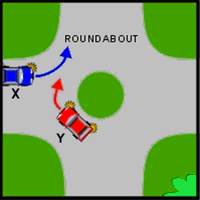
Which vehicle must give way?
ANeither vehicle has to give way.
BVehicle Y.
CVehicle X.
View answer and explanation
Answer: C
When entering a roundabout, you must give way to all vehicles already in the roundabout and any vehicle approaching from your right, which means Vehicle X must give way to Vehicle Y.
📖 Reference: 3.13 — Intersections (give way). Give way to all traffic coming from the left or right, including turning vehicles. A vehicle entering a road from a driveway or terminating road must give way to traffic on the continuing road.
Q0217Quiz 8Traffic Lights
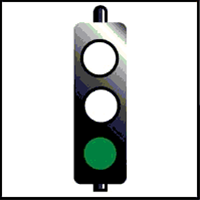
If you are turning right at traffic lights and the light is green (as shown in the diagram), what should you do?
ATurn only if you can do so without interfering with other traffic.
BWait until the light changes to red and then turn quickly.
CDo not move until the light changes to yellow and then turn quickly.
View answer and explanation
Answer: A
A green light means you may proceed, but when turning right you must give way to oncoming traffic and pedestrians, so you should only turn when it is safe to do so.
📖 Reference: 3.10.1 / 3.13.1 — Traffic control signals / Intersections. When turning right at a green light you must give way to oncoming traffic and pedestrians. Green means proceed only if the way is clear.
Q0218Quiz 8Mobile · Fatigue
Are you allowed to use a hand-held mobile phone while driving?
ANo.
BYes, providing you do not lose concentration.
CYes.
View answer and explanation
Answer: A
Do not hold a mobile phone while driving.
📖 Reference: 1.7 — Mobile Phones. A mobile phone may only be used by the driver while driving if it is secured in a mounting affixed to the vehicle or can be operated without touching it (voice activated). You must not use a hand-held phone while driving.
Q0219Quiz 8Emergencies · First Aid
What should you do if an emergency vehicle is using a siren or flashing lights?
AFlash your headlights to warn other drivers.
BAccelerate to avoid the emergency vehicle.
CGive way by moving to the left or right, if it is safe to do so.
View answer and explanation
Answer: C
Emergency vehicles with sirens or flashing lights: when safe, pull over to the left or right to yield.
📖 Reference: 3.1.3 — Passing incident response vehicles. It is an offence not to give way to an emergency vehicle. Slow down and, if safe to do so, move over when passing stationary incident response vehicles displaying flashing lights (Slow Down, Move Over – SLOMO).
Q0220Quiz 8Pedestrians · Buses
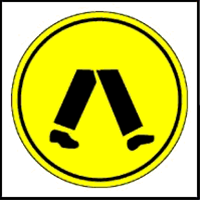
What is the meaning of this sign?
ACaution, school ahead.
BCaution, pedestrian crossing ahead.
CCaution, traffic lights ahead.
View answer and explanation
Answer: B
The sign displays a symbol of walking legs, which is the standard warning symbol for a pedestrian crossing ahead.
📖 Reference: 3.8 — Traffic Signs. Signs are installed along our roads to make them safer for all users. Regulatory signs control traffic and must be obeyed; warning signs (diamond-shaped) alert you to hazards ahead.
Q0221Quiz 8Give Way · Intersections
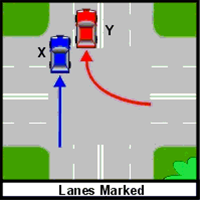
Which vehicle must give way?
ANeither vehicle has to give way.
BVehicle Y.
CVehicle X.
View answer and explanation
Answer: B
At an uncontrolled intersection (no signs or traffic lights), drivers must give way to vehicles approaching from their right. Vehicle X is approaching from the right of Vehicle Y.
📖 Reference: 3.13 — Intersections (give way). Give way to all traffic coming from the left or right, including turning vehicles. A vehicle entering a road from a driveway or terminating road must give way to traffic on the continuing road.
Q0222Quiz 8Overtaking · Lanes
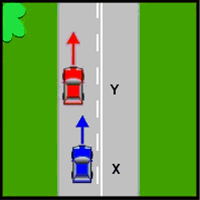
Is vehicle X allowed to overtake vehicle Y?
ANo.
BYes, if it is safe to do so.
CIt depends on the weather conditions.
View answer and explanation
Answer: B
The broken white line separating the lanes indicates that vehicles are permitted to cross it to overtake, provided the way is clear and it is safe to do so.
📖 Reference: 3.16 — Overtaking. To overtake safely you must get a good view of the road ahead, check mirrors and blind spots, and only overtake when it is safe. You must not exceed the speed limit to overtake, and you must not overtake unless it can be done safely.
Q0223Quiz 8Lights · Weather
What should you do when travelling behind a vehicle in wet weather?
ADrive the same as you would in dry weather conditions.
BKeep a greater distance behind the vehicle than normal.
CKeep a closer distance behind the vehicle than normal.
View answer and explanation
Answer: B
Increase your following distance in rainy weather.
📖 Reference: 3.3.2 — Driving in wet or hazardous weather. When the road is wet, braking distance increases; braking hard on a wet road may cause your car to skid. To improve safety in wet weather, use your headlights and watch out for pedestrians, cyclists and other hazards.
Q0224Quiz 8Alcohol · Drugs
How do even small amounts of alcohol affect your driving?
ABy making you think you are driving better than you are.
BBy helping your driving ability.
CBy helping your judgement of speed.
View answer and explanation
Answer: A
A small amount of alcohol can make you overestimate your driving ability.
📖 Reference: 1.3.3 / 1.3.4 — Blood alcohol concentration (BAC). All novice drivers are subject to a zero blood alcohol limit (0.00%). The BAC limit for full licence drivers is 0.05%. Alcohol slows down your reaction time to road hazards and gives you a false sense of confidence.
Q0225Quiz 8Markings · Signs
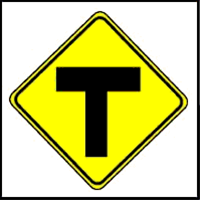
What is the meaning of this sign?
ACaution, you are approaching a one-way street.
BCaution, you are approaching a 'T' junction.
CCaution, no through road.
View answer and explanation
Answer: B
A yellow diamond-shaped sign with a black 'T' symbol is a standard
📖 Reference: 3.8 — Traffic Signs. Signs are installed along our roads to make them safer for all users. Regulatory signs control traffic and must be obeyed; warning signs (diamond-shaped) alert you to hazards ahead.
Q0227Quiz 8Speed · Distances
Are you allowed to travel faster than the speed limit when you are overtaking a vehicle?
ANo.
BYes.
CYes, if the driver of the vehicle in front signals you to overtake.
View answer and explanation
Answer: A
When overtaking, you must not exceed the speed limit.
📖 Reference: 3.16 — Overtaking. To overtake safely you must get a good view of the road ahead, check mirrors and blind spots, and only overtake when it is safe. You must not exceed the speed limit to overtake, and you must not overtake unless it can be done safely.
Q0228Quiz 8Overtaking · Lanes
Which of the following statements is correct?
AVehicle X may overtake Y, only in a 60km/h area.
BVehicle X must not overtake Y.
CVehicle X may overtake Y.
View answer and explanation
Answer: C
Vehicle X may overtake Vehicle Y on the left because Vehicle Y is turning right. This is a specific exception to the general rule of overtaking on the right.
📖 Reference: 3.13 — Intersections (give way). Give way to all traffic coming from the left or right, including turning vehicles. A vehicle entering a road from a driveway or terminating road must give way to traffic on the continuing road.
Q0229Quiz 8Give Way · Intersections
When you want to cross an intersection, but you can see that the traffic ahead of you is banked up on the other side of the intersection, what must you do?
ASound your horn and move slowly forward.
BStop before entering and make sure that you will not block the intersection if you join the queue.
CJoin the queue of traffic.
View answer and explanation
Answer: B
When traffic is jammed, do not enter the intersection.
📖 Reference: 3.13.4 — Keep intersections clear. Do not enter an intersection when a queue of traffic prevents you from fully exiting on the other side. Stop before you enter the intersection so that you do not block crossing traffic.
Q0230Quiz 8Pedestrians · Buses
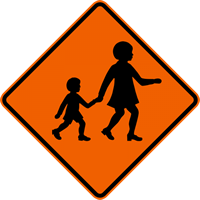
What is the meaning of this sign?
ACaution, an attended children's crossing is ahead.
BCaution, watch out for children.
CCaution, stop immediately if you see children.
View answer and explanation
Answer: B
Official answer: Caution, watch out for children — this is a general children warning sign.
📖 Reference: 3.8 — Traffic Signs. Signs are installed along our roads to make them safer for all users. Regulatory signs control traffic and must be obeyed; warning signs (diamond-shaped) alert you to hazards ahead.
Q0231Quiz 8Alcohol · Drugs
What is the legal blood alcohol concentration (BAC) for drivers with a full licence?
ALess than 0.02%.
BLess than 0.05%.
CLess than 0.08%.
View answer and explanation
Answer: B
For a full driver’s licence, the legal blood alcohol concentration (BAC) limit is under 0.05%.
📖 Reference: 1.3.3 / 1.3.4 — Blood alcohol concentration (BAC). All novice drivers are subject to a zero blood alcohol limit (0.00%). The BAC limit for full licence drivers is 0.05%. Alcohol slows down your reaction time to road hazards and gives you a false sense of confidence.
Q0232Quiz 8Seatbelts · Vehicle
Who will be fined if a passenger under the age of 16 is not wearing a seat belt or suitable child restraint?
AThe owner of the vehicle.
BThe passenger.
CThe driver of the vehicle.
View answer and explanation
Answer: C
If a passenger under 16 isn't wearing a seatbelt, the driver gets the fine.
📖 Reference: 1.4.4 — Who must wear a seat belt?. The driver and each passenger must be appropriately restrained and in a seated position. Seat belts must be worn by pregnant women. Children under 7 years must wear a suitable child restraint. You do not have to wear a seat belt when reversing.
Q0233Quiz 8Markings · Signs
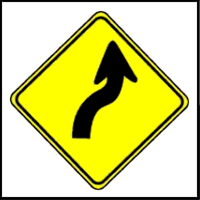
What is the meaning of this sign?
AThere is a steep hill ahead.
BSlow down for a dip in the road.
CCaution, the road curves right, then left.
View answer and explanation
Answer: C
This is a yellow diamond warning sign with a curved arrow, indicating a curve in the road ahead. Options A and B show changes in road gradient (hill and dip), which have different symbols.
📖 Reference: 3.8 — Traffic Signs. Signs are installed along our roads to make them safer for all users. Regulatory signs control traffic and must be obeyed; warning signs (diamond-shaped) alert you to hazards ahead.
Q0234Quiz 8Railway Crossings
What should you do when approaching a railway crossing?
ASpeed up to clear the crossing quickly.
BSlow down and be prepared to stop.
CSound your horn.
View answer and explanation
Answer: B
When approaching a railway crossing, slow down and be prepared to stop.
📖 Reference: 3.5 — Railway Crossings. You must stop if warning bells or flashing red lights are operating, boom gates are down, or a train is coming. You may drive on only when it is safe and no train is approaching; if lights are still flashing you must not cross.
Q0235Quiz 8Give Way · Intersections
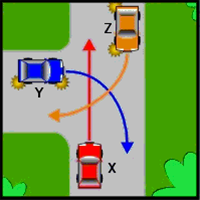
Which of the following statements is correct?
AVehicle Y gives way to both X and Z.
BVehicle X gives way to both Y and Z.
CVehicle Z gives way to both X and Y.
View answer and explanation
Answer: A
Vehicle Y is at a T-intersection on the terminating road and must give way to all vehicles on the continuing road (Vehicle X going straight and Vehicle Z turning right).
📖 Reference: 3.13 — Intersections (give way). Give way to all traffic coming from the left or right, including turning vehicles. A vehicle entering a road from a driveway or terminating road must give way to traffic on the continuing road.
Q0236Quiz 8Overtaking · Lanes
What should you do if you are travelling slowly on a two-way road and there is a queue of vehicles behind you?
APull well over to the left and allow the vehicles to overtake you.
BKeep to the middle of the road to prevent dangerous overtaking.
CKeep well to the right so the queue of vehicles can overtake on the left.
View answer and explanation
Answer: A
When a line of vehicles is overtaking you, keep left and give way.
📖 Reference: 3.4 — Keeping to the Left. If you are driving a slow moving vehicle, pull well over to the left to allow following traffic to overtake.