Pedestrians · Buses

30 questions · Based on public Transport WA materials · English explanations and handbook references

Q0004Quiz 1

Who must give way?
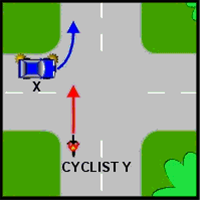
Illustration for question Q0004
View answer and explanation

Answer: B

At an intersection with no lights or signs, a driver must give way to any vehicle on their right, and a cyclist is treated as a vehicle, so vehicle X must give way to cyclist Y approaching from its right.

📖 Reference: 3.13 — Intersections (give way). Give way to all traffic coming from the left or right, including turning vehicles. A vehicle entering a road from a driveway or terminating road must give way to traffic on the continuing road.
Q0023Quiz 1

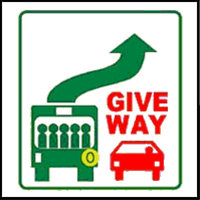
What is the meaning of this sign on the back of a bus?

Illustration for question Q0023
View answer and explanation

Answer: C

This sign indicates that drivers must give way to a bus that is signaling to enter the traffic flow from a bus stop.

📖 Reference: 1.3.3 / 1.3.4 — Blood alcohol concentration (BAC). All novice drivers are subject to a zero blood alcohol limit (0.00%). The BAC limit for full licence drivers is 0.05%. Alcohol slows down your reaction time to road hazards and gives you a false sense of confidence.

Q0031Quiz 2

Who must give way?

Illustration for question Q0031
View answer and explanation

Answer: A

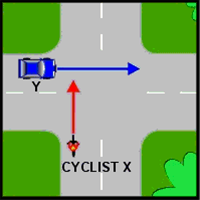
At an intersection with give-way lines (or an uncontrolled intersection), you must give way to vehicles approaching from your right. In this case, the cyclist is approaching from Vehicle Y's right, so Vehicle Y must give way.

📖 Reference: 3.13 — Intersections (give way). Give way to all traffic coming from the left or right, including turning vehicles. A vehicle entering a road from a driveway or terminating road must give way to traffic on the continuing road.
Q0060Quiz 2

What should you do if you see animals on the road ahead?

View answer and explanation

Answer: A

Animals on the road: slow down and be prepared to stop.

📖 Reference: 5.8 — Horse and Animal Traffic. If you see livestock on the road ahead, slow down and be prepared to stop. Do not sound your horn or accelerate as this may frighten the animal.

Q0061Quiz 3

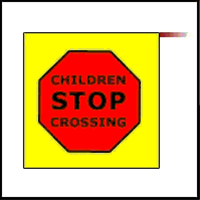
What must you do at a children's crossing when a crossing attendant extends this flag?

Illustration for question Q0061
View answer and explanation

Answer: A

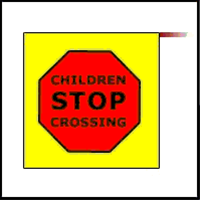
When a crossing attendant displays a "STOP" sign at a children's crossing, drivers are legally required to come to a complete stop and must not proceed until the sign is withdrawn.

📖 Reference: 1.8.1 — Pedestrians. Always keep a look out for pedestrians and be ready to stop for them. Give way to pedestrians crossing at intersections and at pedestrian/children’s crossings. At children’s crossings you must stop when the crossing attendant extends the flags.

Q0081Quiz 3

What is the minimum distance a vehicle is allowed to park after a bus stop or pedestrian crossing?

View answer and explanation

Answer: C

No parking within 10 meters after a bus stop or pedestrian crossing (leaving side), or within 20 meters before it (approach side) (Handbook 3.17).

📖 Reference: 3.6 — Buses and Taxis. You must give way to a bus moving out from a bus stop in a ‘built-up’ area providing the bus is indicating and has a ‘GIVE WAY’ sign displayed on the back.

Q0089Quiz 3

What is the rule regarding overtaking at a pedestrian crossing?

View answer and explanation

Answer: A

Do not overtake vehicles that have stopped before a pedestrian crossing.

📖 Reference: 3.16 — Overtaking. To overtake safely you must get a good view of the road ahead, check mirrors and blind spots, and only overtake when it is safe. You must not exceed the speed limit to overtake, and you must not overtake unless it can be done safely.

Q0098Quiz 4

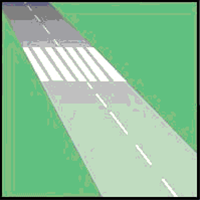
Are you allowed to park a vehicle on a pedestrian crossing?

Illustration for question Q0098
View answer and explanation

Answer: C

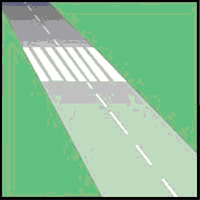
Parking or stopping on a pedestrian crossing is illegal because it blocks pedestrians and reduces visibility for other drivers.

📖 Reference: 1.8.1 — Pedestrians. Always keep a look out for pedestrians and be ready to stop for them. Give way to pedestrians crossing at intersections and at pedestrian/children’s crossings. At children’s crossings you must stop when the crossing attendant extends the flags.

Q0105Quiz 4

What is the minimum distance a vehicle is allowed to park before a bus stop or pedestrian crossing?

View answer and explanation

Answer: A

No parking within 20 meters before a bus stop or pedestrian crossing.

📖 Reference: 3.6 — Buses and Taxis. You must give way to a bus moving out from a bus stop in a ‘built-up’ area providing the bus is indicating and has a ‘GIVE WAY’ sign displayed on the back.

Q0117Quiz 4

What should you do when approaching a pedestrian crossing area?

View answer and explanation

Answer: C

Approaching a pedestrian crossing: slow down and be ready to stop.

📖 Reference: 1.8.1 — Pedestrians. Always keep a look out for pedestrians and be ready to stop for them. Give way to pedestrians crossing at intersections and at pedestrian/children’s crossings. At children’s crossings you must stop when the crossing attendant extends the flags.

Q0122Quiz 5

When driving, what should you do if a ball suddenly bounces across the road in front of you?

View answer and explanation

Answer: A

A ball rolling onto the road means a child may be chasing it. Slow down and be ready to stop.

📖 Reference: 1.8.1 — Pedestrians. Always be ready to stop for pedestrians, especially near schools and playgrounds. A ball bouncing onto the road means children may follow – slow down and be prepared to stop.

Q0128Quiz 5

Which of the following statements is correct?

View answer and explanation

Answer: C

Pay special attention to cyclists and pedestrians at night.

📖 Reference: 3.13 — Intersections (give way). Give way to all traffic coming from the left or right, including turning vehicles. A vehicle entering a road from a driveway or terminating road must give way to traffic on the continuing road.
Q0130Quiz 5

When passing a row of parked vehicles, what should you do?

View answer and explanation

Answer: B

When passing parked vehicles at the roadside, watch for pedestrians stepping out suddenly.

📖 Reference: 1.8.1 — Pedestrians. Watch out for pedestrians who might step out suddenly from between parked cars. Always keep a look out for pedestrians and be ready to stop for them.

Q0138Quiz 5

What should you do to improve safety when travelling in heavy rain?

View answer and explanation

Answer: A

In heavy rain: turn on your lights and watch out for pedestrians, cyclists, and other hazards.

📖 Reference: 3.3.2 — Driving in wet or hazardous weather. When the road is wet, braking distance increases; braking hard on a wet road may cause your car to skid. To improve safety in wet weather, use your headlights and watch out for pedestrians, cyclists and other hazards.

Q0151Quiz 6

What is the reduced speed limit around schools during certain times of the day?

View answer and explanation

Answer: B

In school zones, the speed limit is 40 km/h during the designated times.

📖 Reference: 3.1.1 — Speed Limits. In a ‘built-up’ area, the default speed limit is 50 km/h unless a sign shows a different speed. Learner drivers: 100 km/h. Vehicles towing caravans or trailers: 100 km/h. Roadworks: obey the speed limit shown on the sign.

Q0156Quiz 6

Who must give way?

Illustration for question Q0156
View answer and explanation

Answer: B

📖 Reference: 3.13 — Intersections (give way). Give way to all traffic coming from the left or right, including turning vehicles. A vehicle entering a road from a driveway or terminating road must give way to traffic on the continuing road.
Q0176Quiz 6

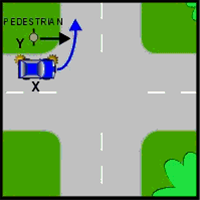
Who must give way?

Illustration for question Q0176
View answer and explanation

Answer: B

📖 Reference: 3.13 — Intersections (give way). Give way to all traffic coming from the left or right, including turning vehicles. A vehicle entering a road from a driveway or terminating road must give way to traffic on the continuing road.
Q0181Quiz 7

If you are turning at an intersection where there are no traffic lights and pedestrians are crossing the road, what must you do?

View answer and explanation

Answer: C

When turning at an intersection without traffic lights, always yield to pedestrians crossing the road.

📖 Reference: 3.10.1 — Intersection traffic control signals. Red means STOP. When the light is red, you must wait behind the stop line. A green arrow permits movement in the direction of the arrow; other lights still apply to other directions.

Q0206Quiz 7

If you are turning at traffic lights and pedestrians are crossing the road, what must you do?

View answer and explanation

Answer: A

When turning at a signalized intersection, yield to pedestrians who are crossing the road.

📖 Reference: 3.10.1 — Intersection traffic control signals. Red means STOP. When the light is red, you must wait behind the stop line. A green arrow permits movement in the direction of the arrow; other lights still apply to other directions.

Q0220Quiz 8

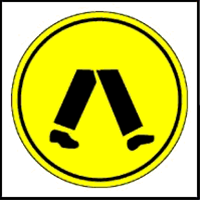
What is the meaning of this sign?

Illustration for question Q0220
View answer and explanation

Answer: B

The sign displays a symbol of walking legs, which is the standard warning symbol for a pedestrian crossing ahead.

📖 Reference: 3.8 — Traffic Signs. Signs are installed along our roads to make them safer for all users. Regulatory signs control traffic and must be obeyed; warning signs (diamond-shaped) alert you to hazards ahead.

Q0230Quiz 8

What is the meaning of this sign?

Illustration for question Q0230
View answer and explanation

Answer: B

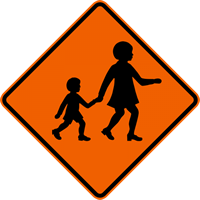
Official answer: Caution, watch out for children — this is a general children warning sign.

📖 Reference: 3.8 — Traffic Signs. Signs are installed along our roads to make them safer for all users. Regulatory signs control traffic and must be obeyed; warning signs (diamond-shaped) alert you to hazards ahead.

Q0249Quiz 9

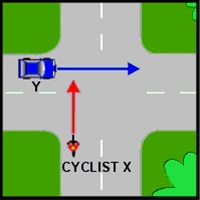
Who must give way?

Illustration for question Q0249
View answer and explanation

Answer: A

Vehicle Y must give way because there are give way lines (dashed white lines) across its lane at the intersection, requiring it to yield to traffic on the intersecting road (Cyclist X).

📖 Reference: 3.13 — Intersections (give way). Give way to all traffic coming from the left or right, including turning vehicles. A vehicle entering a road from a driveway or terminating road must give way to traffic on the continuing road.
Q0272Quiz 10

Are you allowed to park a vehicle on a pedestrian crossing?

Illustration for question Q0272
View answer and explanation

Answer: C

Parking or stopping on a pedestrian crossing is illegal because it obstructs pedestrians' path and visibility.

📖 Reference: 1.8.1 — Pedestrians. Always keep a look out for pedestrians and be ready to stop for them. Give way to pedestrians crossing at intersections and at pedestrian/children’s crossings. At children’s crossings you must stop when the crossing attendant extends the flags.

Q0274Quiz 10

What is the minimum distance a vehicle is allowed to park before a bus stop or pedestrian crossing?

View answer and explanation

Answer: A

No parking within 20 meters before a bus stop or pedestrian crossing.

📖 Reference: 3.6 — Buses and Taxis. You must give way to a bus moving out from a bus stop in a ‘built-up’ area providing the bus is indicating and has a ‘GIVE WAY’ sign displayed on the back.

Q0287Quiz 10

What is the reduced speed limit around schools during certain times of the day?

View answer and explanation

Answer: B

School zone speed limit: 40 km/h.

📖 Reference: 3.1.1 — Speed Limits. In a ‘built-up’ area, the default speed limit is 50 km/h unless a sign shows a different speed. Learner drivers: 100 km/h. Vehicles towing caravans or trailers: 100 km/h. Roadworks: obey the speed limit shown on the sign.

Q0288Quiz 10

What must you do at a children's crossing when a crossing attendant extends this flag?

Illustration for question Q0288
View answer and explanation

Answer: A

When a crossing attendant displays the red "Children Stop Crossing" flag, you must come to a complete stop at the stop line and remain stopped until the attendant removes the sign.

📖 Reference: 1.8.1 — Pedestrians. Always keep a look out for pedestrians and be ready to stop for them. Give way to pedestrians crossing at intersections and at pedestrian/children’s crossings. At children’s crossings you must stop when the crossing attendant extends the flags.

Q0303Quiz 11

What is the minimum distance a vehicle is allowed to park after a bus stop or pedestrian crossing?

View answer and explanation

Answer: C

Parking is prohibited within 10 meters of the departure side of a bus stop or pedestrian crossing (Handbook 3.17).

📖 Reference: 3.6 — Buses and Taxis. You must give way to a bus moving out from a bus stop in a ‘built-up’ area providing the bus is indicating and has a ‘GIVE WAY’ sign displayed on the back.

Q0306Quiz 11

What should you do to improve safety when travelling in heavy rain?

View answer and explanation

Answer: A

In heavy rain, turn on your lights and watch out for pedestrians and cyclists.

📖 Reference: 3.3.2 — Driving in wet or hazardous weather. When the road is wet, braking distance increases; braking hard on a wet road may cause your car to skid. To improve safety in wet weather, use your headlights and watch out for pedestrians, cyclists and other hazards.

Q0309Quiz 11

If you are turning at traffic lights and pedestrians are crossing the road, what must you do?

View answer and explanation

Answer: A

When turning at a signalized intersection, yield to pedestrians crossing the road.

📖 Reference: 3.10.1 — Intersection traffic control signals. Red means STOP. When the light is red, you must wait behind the stop line. A green arrow permits movement in the direction of the arrow; other lights still apply to other directions.

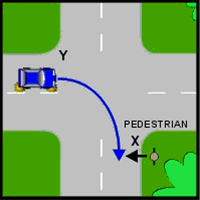
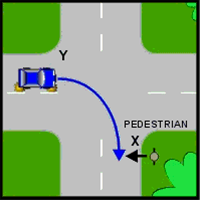
Q0318Quiz 11

Who must give way?

Illustration for question Q0318
View answer and explanation

Answer: B

When turning at an intersection, drivers must yield to pedestrians crossing the road they are turning into.

📖 Reference: 3.13 — Intersections (give way). Give way to all traffic coming from the left or right, including turning vehicles. A vehicle entering a road from a driveway or terminating road must give way to traffic on the continuing road.